
Mae gwenithfaen yn fath o graig igneaidd sy'n cael ei gloddio am ei gryfder, ei ddwysedd, ei wydnwch a'i wrthwynebiad eithafol i gyrydiad. Ond mae gwenithfaen hefyd yn amlbwrpas iawn - nid dim ond ar gyfer sgwariau a phetryalau y mae! Mewn gwirionedd, rydym yn gweithio'n hyderus gyda chydrannau gwenithfaen wedi'u peiriannu mewn siapiau, onglau a chromliniau o bob amrywiad yn rheolaidd - gyda chanlyniadau rhagorol.
Drwy ein prosesu o'r radd flaenaf, gall arwynebau wedi'u torri fod yn eithriadol o wastad. Mae'r rhinweddau hyn yn gwneud gwenithfaen yn ddeunydd delfrydol i greu seiliau peiriannau a chydrannau metroleg o faint a dyluniad arferol. Mae gwenithfaen yn:
■ peiriannadwy
■ union wastad ar ôl ei dorri a'i orffen
■ gwrthsefyll rhwd
■ gwydn
■ parhaol
Mae cydrannau gwenithfaen hefyd yn hawdd i'w glanhau. Wrth greu dyluniadau wedi'u teilwra, gwnewch yn siŵr eich bod yn dewis gwenithfaen oherwydd ei fanteision uwch.
SAFONAU / CEISIADAU GWISGO UCHEL
Mae gan y gwenithfaen a ddefnyddir gan ZHHIMG ar gyfer ein cynhyrchion platiau arwyneb safonol gynnwys cwarts uchel, sy'n darparu mwy o wrthwynebiad i wisgo a difrod. Mae gan ein lliwiau Du Superior gyfraddau amsugno dŵr isel, gan leihau'r posibilrwydd y bydd eich mesuryddion manwl gywir yn rhydu wrth osod ar y platiau. Mae lliwiau'r gwenithfaen a gynigir gan ZHHIMG yn arwain at lai o lewyrch, sy'n golygu llai o straen ar y llygaid i unigolion sy'n defnyddio'r platiau. Rydym wedi dewis ein mathau o wenithfaen wrth ystyried ehangu thermol mewn ymdrech i gadw'r agwedd hon yn fach iawn.
CEISIADAU ARBENNIG
Pan fydd eich cymhwysiad yn galw am blât gyda siapiau personol, mewnosodiadau edau, slotiau neu beiriannu arall, byddwch chi eisiau dewis deunydd fel Du Jinan Du. Mae'r deunydd naturiol hwn yn cynnig anystwythder uwch, lliniaru dirgryniad rhagorol, a pheiriannu gwell.
Mae'n bwysig nodi nad yw lliw yn unig yn arwydd o rinweddau ffisegol y garreg. Yn gyffredinol, mae lliw gwenithfaen yn uniongyrchol gysylltiedig â phresenoldeb neu absenoldeb mwynau, a allai fod heb unrhyw effaith ar y rhinweddau sy'n gwneud deunydd plât arwyneb da. Mae gwenithfaen pinc, llwyd a du sy'n ardderchog ar gyfer platiau arwyneb, yn ogystal â gwenithfaen du, llwyd a phinc sy'n gwbl anaddas ar gyfer cymwysiadau manwl gywir. Nid oes gan nodweddion hanfodol gwenithfaen, fel y maent yn ymwneud â'i ddefnydd fel deunydd plât arwyneb, ddim i'w wneud â lliw, ac maent fel a ganlyn:
■ Anystwythder (gwyriad o dan lwyth - a nodir gan Fodwlws Elastigedd)
■ Caledwch
■ Dwysedd
■ Gwrthiant gwisgo
■ Sefydlogrwydd
■ Mandylledd
Rydym wedi profi llawer o ddeunyddiau gwenithfaen a'u cymharu. Yn olaf, cawsom y canlyniad, gwenithfaen du Jinan yw'r deunydd gorau rydyn ni erioed wedi'i adnabod. Mae gwenithfaen du Indiaidd a gwenithfaen De Affrica yn debyg i Wenithfaen Du Jinan, ond mae eu priodweddau ffisegol yn llai na Gwenithfaen Du Jinan. Bydd ZHHIMG yn parhau i chwilio am fwy o ddeunyddiau gwenithfaen yn y byd ac yn cymharu eu priodweddau ffisegol.
I siarad mwy am y gwenithfaen sy'n iawn ar gyfer eich prosiect, cysylltwch â niinfo@zhhimg.com.
Mae gwahanol wneuthurwyr yn defnyddio gwahanol safonau. Mae yna lawer o safonau yn y byd.
Safon DIN, ASME B89.3.7-2013 neu Fanyleb Ffederal GGG-P-463c (Platiau Arwyneb Gwenithfaen) ac yn y blaen fel sail ar gyfer eu manylebau.
A gallwn gynhyrchu plât archwilio manwl gwenithfaen yn ôl eich gofynion. Croeso i chi gysylltu â ni os ydych chi eisiau gwybod mwy o wybodaeth am fwy o safonau.
Gellir ystyried gwastadrwydd fel pob pwynt ar yr wyneb wedi'i gynnwys o fewn dau awyren gyfochrog, sef awyren y sylfaen a awyren y to. Mesuriad y pellter rhwng yr awyrennau yw gwastadrwydd cyffredinol yr wyneb. Mae gan y mesuriad gwastadrwydd hwn fel arfer oddefgarwch a gall gynnwys dynodiad gradd.
Er enghraifft, diffinnir y goddefiannau gwastadrwydd ar gyfer tair gradd safonol yn y fanyleb ffederal fel y'u pennir gan y fformiwla ganlynol:
■ Gradd Labordy AA = (40 + croeslin sgwâr/25) x .000001" (unochrog)
■ Gradd Arolygu A = Gradd Labordy AA x 2
■ Ystafell Offer Gradd B = Labordy Gradd AA x 4.
Ar gyfer platiau wyneb o faint safonol, rydym yn gwarantu goddefiannau gwastadrwydd sy'n rhagori ar ofynion y fanyleb hon. Yn ogystal â gwastadrwydd, mae ASME B89.3.7-2013 a Manyleb Ffederal GGG-P-463c yn mynd i'r afael â phynciau gan gynnwys: cywirdeb mesur ailadroddus, priodweddau deunydd gwenithfaen platiau wyneb, gorffeniad wyneb, lleoliad pwynt cynnal, anystwythder, dulliau archwilio derbyniol, gosod mewnosodiadau edau, ac ati.
Mae platiau wyneb gwenithfaen ZHHIMG a phlatiau archwilio gwenithfaen yn bodloni neu'n rhagori ar yr holl ofynion a nodir yn y fanyleb hon. Ar hyn o bryd, nid oes manyleb ddiffiniol ar gyfer platiau ongl gwenithfaen, paralelau, na sgwariau meistr.
A gallwch ddod o hyd i'r fformwlâu ar gyfer safonau eraill ynLAWRLWYTHO.
Yn gyntaf, mae'n bwysig cadw'r plât yn lân. Llwch sgraffiniol yn yr awyr yw'r ffynhonnell fwyaf o draul a rhwyg ar blât fel arfer, gan ei fod yn tueddu i ymgorffori mewn darnau gwaith ac arwynebau cyswllt mesuryddion. Yn ail, gorchuddiwch eich plât i'w amddiffyn rhag llwch a difrod. Gellir ymestyn oes traul trwy orchuddio'r plât pan nad yw'n cael ei ddefnyddio, trwy gylchdroi'r plât o bryd i'w gilydd fel nad yw un ardal yn cael ei defnyddio'n ormodol, a thrwy ddisodli padiau cyswllt dur ar fesuryddion gyda phadiau carbid. Hefyd, osgoi gosod bwyd neu ddiodydd meddal ar y plât. Sylwch fod llawer o ddiodydd meddal yn cynnwys asid carbonig neu ffosfforig, a all doddi'r mwynau meddalach a gadael pyllau bach yn yr wyneb.
Mae hyn yn dibynnu ar sut mae'r plât yn cael ei ddefnyddio. Os yn bosibl, rydym yn argymell glanhau'r plât ar ddechrau'r dydd (neu shifft gwaith) ac eto ar y diwedd. Os bydd y plât yn mynd yn fudr, yn enwedig gyda hylifau olewog neu gludiog, mae'n debyg y dylid ei lanhau ar unwaith.
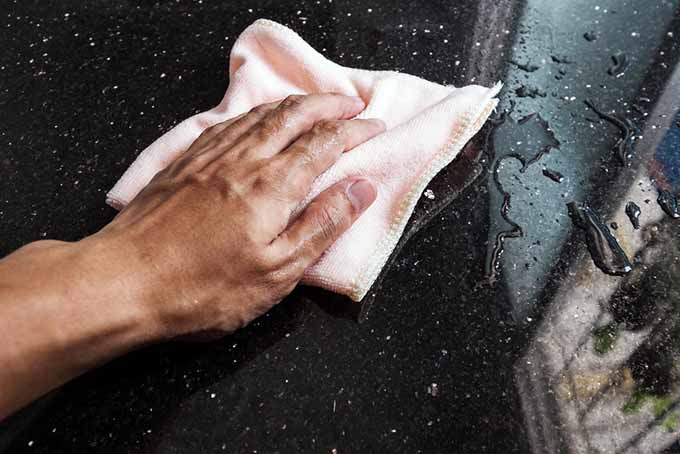
Glanhewch y plât yn rheolaidd gyda glanhawr platiau wyneb hylif neu ddi-ddŵr ZHHIMG. Mae'r dewis o doddiannau glanhau yn bwysig. Os defnyddir toddydd anweddol (aseton, teneuach lacr, alcohol, ac ati) bydd yr anweddiad yn oeri'r wyneb, ac yn ei ystumio. Yn yr achos hwn, mae angen caniatáu i'r plât normaleiddio cyn ei ddefnyddio neu bydd gwallau mesur yn digwydd.
Bydd yr amser sydd ei angen i'r plât normaleiddio yn amrywio yn ôl maint y plât, a faint o oeri. Dylai awr fod yn ddigonol ar gyfer platiau llai. Efallai y bydd angen dwy awr ar gyfer platiau mwy. Os defnyddir glanhawr sy'n seiliedig ar ddŵr, bydd rhywfaint o oeri anweddol hefyd.
Bydd y plât hefyd yn cadw'r dŵr, a gallai hyn achosi i rannau metel sy'n dod i gysylltiad â'r wyneb rydu. Bydd rhai glanhawyr hefyd yn gadael gweddillion gludiog ar ôl iddynt sychu, a fydd yn denu llwch yn yr awyr, ac mewn gwirionedd yn cynyddu traul, yn hytrach na'i leihau.
Mae hyn yn dibynnu ar y defnydd a wneir o'r plât a'r amgylchedd. Rydym yn argymell bod plât newydd neu ategolion gwenithfaen manwl yn cael eu hail-raddnodi'n llawn o fewn blwyddyn i'w brynu. Os bydd y plât wyneb gwenithfaen yn cael ei ddefnyddio'n helaeth, efallai y byddai'n ddoeth byrhau'r cyfnod hwn i chwe mis. Bydd archwiliad misol am wallau mesur ailadroddus gan ddefnyddio lefel electronig, neu ddyfais debyg, yn dangos unrhyw fannau gwisgo sy'n datblygu a dim ond ychydig funudau y bydd yn eu cymryd i'w berfformio. Ar ôl pennu canlyniadau'r ail-raddnodi cyntaf, gellir ymestyn neu fyrhau'r cyfnod graddnodi fel y caniateir neu sy'n ofynnol gan eich system ansawdd fewnol.
Gallwn gynnig gwasanaeth i'ch helpu i archwilio a graddnodi'ch plât wyneb gwenithfaen.

Mae sawl achos posibl dros amrywiadau rhwng calibradiadau:
- Golchwyd yr wyneb gyda thoddiant poeth neu oer cyn calibradu, ac ni chaniatawyd digon o amser iddo normaleiddio.
- Mae'r plât wedi'i gefnogi'n amhriodol
- Newid tymheredd
- Drafftiau
- Golau haul uniongyrchol neu wres ymbelydrol arall ar wyneb y plât. Gwnewch yn siŵr nad yw goleuadau uwchben yn cynhesu'r wyneb.
- Amrywiadau yn y graddiant tymheredd fertigol rhwng y gaeaf a'r haf (Os yn bosibl o gwbl, gwyddoch y tymheredd graddiant fertigol ar yr adeg y perfformir y calibradu.)
- Ni chaniatawyd digon o amser i'r plât normaleiddio ar ôl ei gludo
- Defnydd amhriodol o offer archwilio neu ddefnyddio offer heb ei galibro
- Newid arwyneb yn deillio o wisgo
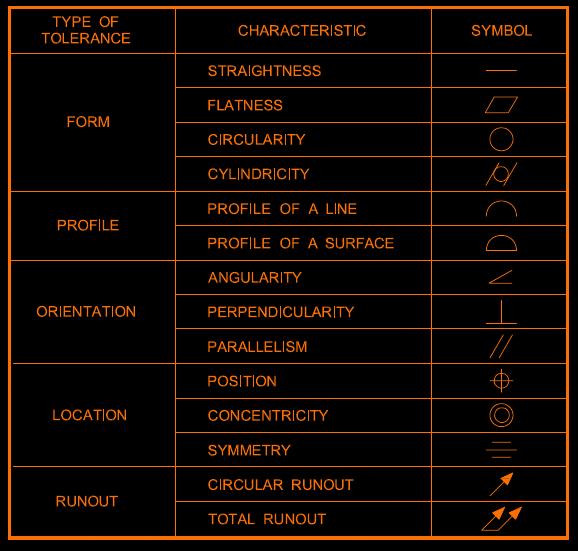
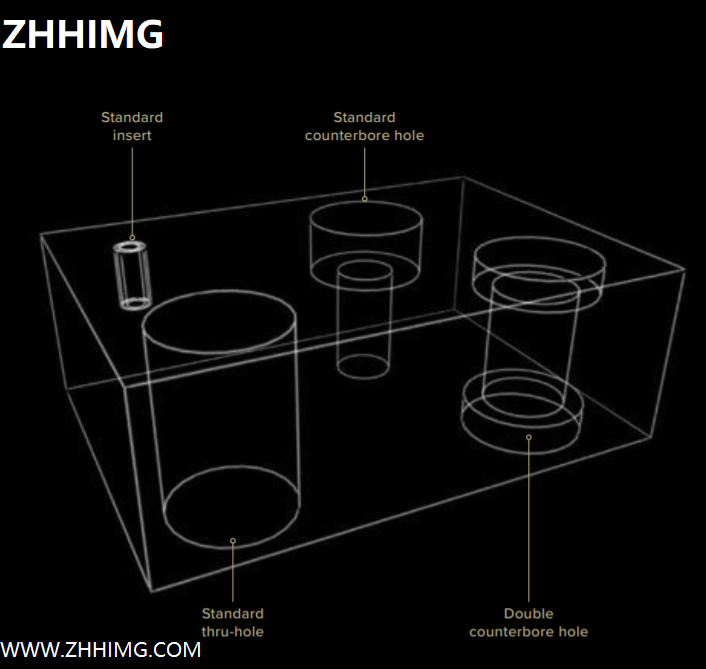
Faint o fathau o dyllau sydd ar wenithfaen manwl gywir?
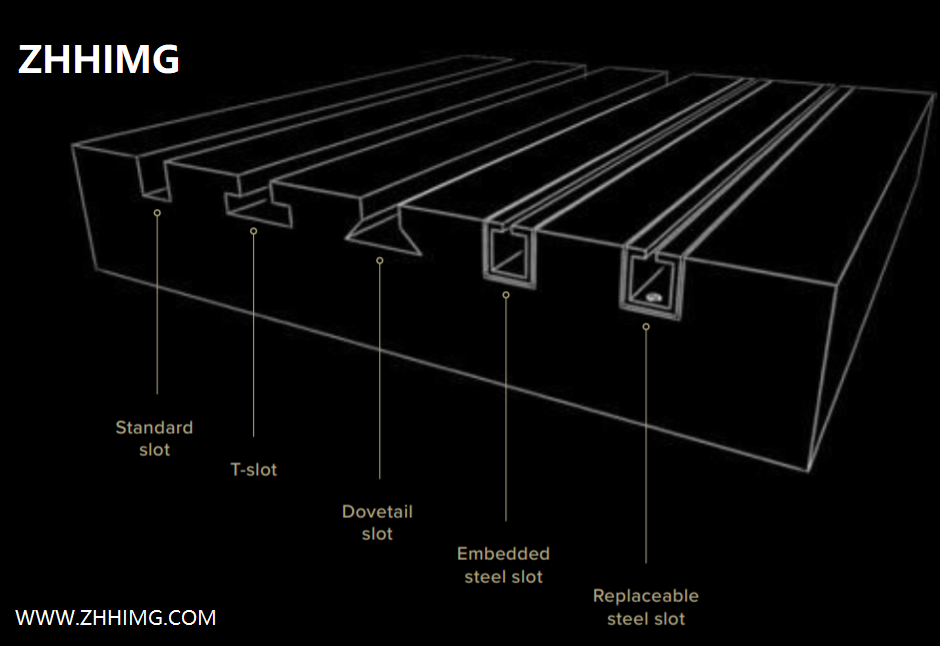
Slotiau ar Gydrannau Gwenithfaen Manwl
I lawer o ffatrïoedd, ystafelloedd archwilio a labordai, mae platiau wyneb gwenithfaen manwl gywir yn cael eu dibynnu ar sail ar gyfer mesur cywir. Gan fod pob mesuriad llinol yn dibynnu ar arwyneb cyfeirio cywir y cymerir y dimensiynau terfynol ohono, mae platiau wyneb yn darparu'r plân cyfeirio gorau ar gyfer archwilio a chynllunio gwaith cyn peiriannu. Maent hefyd yn seiliau delfrydol ar gyfer gwneud mesuriadau uchder a mesur arwynebau. Ymhellach, mae gradd uchel o wastadrwydd, sefydlogrwydd, ansawdd cyffredinol a chrefftwaith yn eu gwneud yn ddewis da ar gyfer gosod systemau mesur mecanyddol, electronig ac optegol soffistigedig. Ar gyfer unrhyw un o'r prosesau mesur hyn, mae'n hanfodol cadw platiau wyneb wedi'u calibro.
Ailadrodd Mesuriadau a Gwastadrwydd
Mae gwastadrwydd ac ailadrodd mesuriadau yn hanfodol i sicrhau arwyneb manwl gywir. Gellir ystyried gwastadrwydd fel pob pwynt ar yr wyneb wedi'i gynnwys o fewn dau awyren gyfochrog, sef awyren y sylfaen a awyren y to. Mesuriad y pellter rhwng yr awyrennau yw gwastadrwydd cyffredinol yr wyneb. Mae gan y mesuriad gwastadrwydd hwn fel arfer oddefgarwch a gall gynnwys dynodiad gradd.
Diffinnir y goddefiannau gwastadrwydd ar gyfer tair gradd safonol yn y fanyleb ffederal fel y'u pennir gan y fformiwla ganlynol:
Safon DIN, Safon GB, Safon ASME, safon JJS ... gwlad wahanol gyda gwahanol safiadau ...
Yn ogystal â gwastadrwydd, rhaid sicrhau ailadroddadwyedd. Mesuriad o ardaloedd gwastadrwydd lleol yw mesuriad ailadroddus. Mae'n fesuriad a gymerir yn unrhyw le ar wyneb plât a fydd yn ailadrodd o fewn y goddefiant a nodwyd. Mae rheoli gwastadrwydd ardal leol i oddefiant tynnach na gwastadrwydd cyffredinol yn gwarantu newid graddol ym mhroffil gwastadrwydd yr wyneb, a thrwy hynny leihau gwallau lleol.
Er mwyn sicrhau bod plât arwyneb yn bodloni'r manylebau gwastadrwydd ac ailadrodd mesur, dylai gweithgynhyrchwyr platiau arwyneb gwenithfaen ddefnyddio Manyleb Ffederal GGG-P-463c fel sail ar gyfer eu manylebau. Mae'r safon hon yn mynd i'r afael â chywirdeb ailadrodd mesur, priodweddau deunydd plât arwyneb gwenithfaen, gorffeniad arwyneb, lleoliad pwynt cynnal, anystwythder, dulliau arolygu derbyniol a gosod mewnosodiadau edau.
Gwirio Cywirdeb y Plât
Drwy ddilyn ychydig o ganllawiau syml, dylai buddsoddiad mewn plât wyneb gwenithfaen bara am flynyddoedd lawer. Yn dibynnu ar y defnydd o'r plât, amgylchedd y siop a'r cywirdeb gofynnol, mae amlder gwirio cywirdeb y plât wyneb yn amrywio. Rheol gyffredinol yw i blât newydd gael ei ail-raddnodi'n llawn o fewn blwyddyn i'w brynu. Os defnyddir y plât yn aml, mae'n ddoeth byrhau'r cyfnod hwn i chwe mis.
Cyn i blât arwyneb wisgo y tu hwnt i'r fanyleb ar gyfer gwastadrwydd cyffredinol, bydd yn dangos pyst treulio neu donnog. Bydd archwiliad misol am wallau mesur ailadroddus gan ddefnyddio mesurydd darllen ailadroddus yn nodi mannau gwisgo. Mae mesurydd darllen ailadroddus yn offeryn manwl iawn sy'n canfod gwall lleol a gellir ei arddangos ar fwyhadur electronig chwyddiad uchel.
Dylai rhaglen arolygu effeithiol gynnwys gwiriadau rheolaidd gydag awtocolimator, gan ddarparu calibradu gwirioneddol o wastadrwydd cyffredinol y gellir ei olrhain i'r Sefydliad Cenedlaethol Safonau a Thechnoleg (NIST). Mae angen calibradu cynhwysfawr gan y gwneuthurwr neu gwmni annibynnol o bryd i'w gilydd.
Amrywiadau Rhwng Calibradau
Mewn rhai achosion, mae amrywiadau rhwng calibradiadau platiau arwyneb. Weithiau gall ffactorau fel newid arwyneb sy'n deillio o wisgo, defnydd anghywir o offer archwilio neu ddefnyddio offer heb ei galibro gyfrif am yr amrywiadau hyn. Y ddau ffactor mwyaf cyffredin, fodd bynnag, yw tymheredd a chefnogaeth.
Un o'r newidynnau pwysicaf yw tymheredd. Er enghraifft, efallai bod yr wyneb wedi'i olchi â thoddiant poeth neu oer cyn calibradu ac nad yw wedi cael digon o amser i normaleiddio. Mae achosion eraill o newid tymheredd yn cynnwys drafftiau o aer oer neu boeth, golau haul uniongyrchol, goleuadau uwchben neu ffynonellau eraill o wres ymbelydrol ar wyneb y plât.
Gall fod amrywiadau hefyd yn y graddiant tymheredd fertigol rhwng y gaeaf a'r haf. Mewn rhai achosion, ni chaniateir digon o amser i'r plât normaleiddio ar ôl ei gludo. Mae'n syniad da cofnodi'r tymheredd graddiant fertigol ar yr adeg y perfformir y calibradu.
Achos cyffredin arall dros amrywiad calibradu yw plât sydd wedi'i gefnogi'n amhriodol. Dylid cefnogi plât arwyneb mewn tair pwynt, wedi'u lleoli'n ddelfrydol 20% o'r hyd i mewn o bennau'r plât. Dylid lleoli dau gefnogaeth 20% o'r lled i mewn o'r ochrau hir, a dylid canoli'r gefnogaeth sy'n weddill.
Dim ond tri phwynt all orffwys yn gadarn ar unrhyw beth ond arwyneb manwl gywir. Bydd ceisio cynnal y plât mewn mwy na thri phwynt yn achosi i'r plât dderbyn ei gefnogaeth o wahanol gyfuniadau o dri phwynt, na fyddant yr un tri phwynt ag y cafodd ei gynnal arnynt yn ystod y cynhyrchiad. Bydd hyn yn cyflwyno gwallau wrth i'r plât wyro i gydymffurfio â'r trefniant cynnal newydd. Ystyriwch ddefnyddio standiau dur gyda thrawstiau cynnal wedi'u cynllunio i alinio â'r pwyntiau cynnal priodol. Mae standiau at y diben hwn ar gael yn gyffredinol gan wneuthurwr y plât arwyneb.
Os yw'r plât wedi'i gynnal yn iawn, dim ond os yw cymhwysiad yn ei nodi y mae angen lefelu manwl gywir. Nid oes angen lefelu i gynnal cywirdeb plât sydd wedi'i gynnal yn iawn.
Ymestyn Bywyd y Plât
Bydd dilyn ychydig o ganllawiau yn lleihau traul ar blât wyneb gwenithfaen ac yn y pen draw, yn ymestyn ei oes.
Yn gyntaf, mae'n bwysig cadw'r plât yn lân. Llwch sgraffiniol yn yr awyr fel arfer yw'r ffynhonnell fwyaf o draul a rhwyg ar blât, gan ei fod yn tueddu i ymgorffori mewn darnau gwaith ac arwynebau cyswllt mesuryddion.
Mae hefyd yn bwysig gorchuddio platiau i'w hamddiffyn rhag llwch a difrod. Gellir ymestyn oes gwisgo trwy orchuddio'r plât pan nad yw'n cael ei ddefnyddio.
Cylchdrowch y plât o bryd i'w gilydd fel nad yw un ardal yn cael ei defnyddio'n ormodol. Hefyd, argymhellir disodli padiau cyswllt dur ar fesuryddion gyda phadiau carbid.
Osgowch osod bwyd neu ddiodydd meddal ar y plât. Mae llawer o ddiodydd meddal yn cynnwys asid carbonig neu ffosfforig, a all doddi'r mwynau meddalach a gadael pyllau bach yn yr wyneb.
Ble i Ail-ymddangos
Pan fydd angen ail-wynebu plât wyneb gwenithfaen, ystyriwch a ddylid cael y gwasanaeth hwn wedi'i gyflawni ar y safle neu yn y cyfleuster calibradu. Mae bob amser yn well cael y plât wedi'i ail-lapio yn y ffatri neu gyfleuster pwrpasol. Fodd bynnag, os nad yw'r plât wedi treulio'n rhy ddrwg, fel arfer o fewn 0.001 modfedd i'r goddefgarwch gofynnol, gellir ei ail-wynebu ar y safle. Os yw plât wedi treulio i'r pwynt lle mae fwy na 0.001 modfedd y tu allan i'r goddefgarwch, neu os yw wedi'i bylu neu ei nicio'n ddrwg, yna dylid ei anfon i'r ffatri i'w falu cyn ei ail-lapio.
Mae gan gyfleuster calibradu'r offer a'r gosodiadau ffatri sy'n darparu'r amodau gorau posibl ar gyfer calibradu platiau priodol ac ailweithio os oes angen.
Dylid bod yn ofalus iawn wrth ddewis technegydd calibradu ac ail-wynebu ar y safle. Gofynnwch am achrediad a gwiriwch fod gan yr offer y bydd y technegydd yn ei ddefnyddio galibradu olrheiniadwy. Mae profiad hefyd yn ffactor pwysig, gan ei fod yn cymryd blynyddoedd lawer i ddysgu sut i lapio gwenithfaen manwl gywir.
Mae mesuriadau critigol yn dechrau gyda phlât wyneb gwenithfaen manwl gywir fel llinell sylfaen. Drwy sicrhau cyfeirnod dibynadwy trwy ddefnyddio plât wyneb wedi'i galibro'n iawn, mae gan weithgynhyrchwyr un o'r offer hanfodol ar gyfer mesuriadau dibynadwy a rhannau o ansawdd gwell.Q
Rhestr wirio ar gyfer Amrywiadau Calibradu
1. Golchwyd yr wyneb gyda thoddiant poeth neu oer cyn calibradu ac ni chaniatawyd digon o amser iddo normaleiddio.
2. Mae'r plât wedi'i gefnogi'n amhriodol.
3. Newid tymheredd.
4. Drafftiau.
5. Golau haul uniongyrchol neu wres ymbelydrol arall ar wyneb y plât. Gwnewch yn siŵr nad yw goleuadau uwchben yn cynhesu'r wyneb.
6. Amrywiadau yn y graddiant tymheredd fertigol rhwng y gaeaf a'r haf. Os yn bosibl o gwbl, gwyddoch y tymheredd graddiant fertigol ar yr adeg y perfformir y calibradu.
7. Ni chaniatawyd digon o amser i'r plât normaleiddio ar ôl ei gludo.
8. Defnydd amhriodol o offer archwilio neu ddefnyddio offer heb ei galibro.
9. Newid arwyneb yn deillio o wisgo.
Awgrymiadau Technegol
- Gan fod pob mesuriad llinol yn dibynnu ar arwyneb cyfeirio cywir y cymerir y dimensiynau terfynol ohono, mae platiau arwyneb yn darparu'r plân cyfeirio gorau ar gyfer archwilio a chynllunio gwaith cyn peiriannu.
- Mae rheoli gwastadrwydd ardal leol i oddefgarwch tynnach na gwastadrwydd cyffredinol yn gwarantu newid graddol ym mhroffil gwastadrwydd yr arwyneb, a thrwy hynny leihau gwallau lleol.
- Dylai rhaglen arolygu effeithiol gynnwys gwiriadau rheolaidd gydag awtocolimator, gan ddarparu calibradu gwirioneddol o wastadrwydd cyffredinol y gellir ei olrhain i'r Awdurdod Arolygu Cenedlaethol.
Ymhlith y gronynnau mwynau sy'n ffurfio gwenithfaen, mae mwy na 90% yn ffelsbar a chwarts, a ffelsbar yw'r mwyaf ohonynt. Mae'r ffelsbar yn aml yn wyn, llwyd, a choch fel y cnawd, ac mae'r cwarts yn bennaf yn ddi-liw neu'n wyn llwydaidd, sy'n ffurfio lliw sylfaenol y gwenithfaen. Mae ffelsbar a chwarts yn fwynau caled, ac mae'n anodd eu symud â chyllell ddur. O ran y smotiau tywyll yn y gwenithfaen, yn bennaf mica du, mae yna rai mwynau eraill. Er bod biotit yn gymharol feddal, nid yw ei allu i wrthsefyll straen yn wan, ac ar yr un pryd mae ganddynt ychydig bach mewn gwenithfaen, yn aml llai na 10%. Dyma'r cyflwr deunydd lle mae gwenithfaen yn arbennig o gryf.
Rheswm arall pam mae gwenithfaen yn gryf yw bod ei ronynnau mwynau wedi'u rhwymo'n dynn i'w gilydd ac wedi'u hymgorffori yn ei gilydd. Yn aml, mae'r mandyllau'n cyfrif am lai nag 1% o gyfanswm cyfaint y graig. Mae hyn yn rhoi'r gallu i'r gwenithfaen wrthsefyll pwysau cryf ac nid yw lleithder yn treiddio iddo'n hawdd.
Mae cydrannau gwenithfaen wedi'u gwneud o garreg heb unrhyw wrthwynebiad rhwd, asid ac alcali, gwrthiant gwisgo da a bywyd gwasanaeth hir, dim cynnal a chadw arbennig. Defnyddir cydrannau manwl gwenithfaen yn bennaf yn offer y diwydiant peiriannau. Felly, fe'u gelwir yn gydrannau manwl gwenithfaen neu gydrannau gwenithfaen. Mae nodweddion cydrannau manwl gwenithfaen yr un fath yn y bôn â nodweddion llwyfannau gwenithfaen. Cyflwyniad i offer a mesur cydrannau manwl gwenithfaen: Mae technoleg peiriannu manwl a micro-beiriannu yn gyfeiriadau datblygu pwysig yn y diwydiant gweithgynhyrchu peiriannau, ac maent wedi dod yn ddangosydd pwysig i fesur lefel uwch-dechnoleg. Mae datblygu technoleg arloesol a'r diwydiant amddiffyn yn anwahanadwy oddi wrth beiriannu manwl a thechnoleg micro-beiriannu. Gellir llithro cydrannau gwenithfaen yn llyfn yn y mesuriad, heb farweidd-dra. Mesur arwyneb gwaith, nid yw crafiadau cyffredinol yn effeithio ar gywirdeb mesur. Mae angen dylunio a chynhyrchu cydrannau gwenithfaen yn unol â gofynion yr ochr galw.
Maes cais:
Fel y gwyddom i gyd, mae mwy a mwy o beiriannau ac offer yn dewis cydrannau gwenithfaen manwl gywir.
Defnyddir cydrannau gwenithfaen ar gyfer symudiad deinamig, moduron llinol, cmm, cnc, peiriant laser...
croeso i chi gysylltu â ni am ragor o wybodaeth.
Mae dyfeisiau mesur gwenithfaen a chydrannau mecanyddol gwenithfaen wedi'u gwneud o wenithfaen Jinan Black o ansawdd uchel. Oherwydd eu cywirdeb uchel, eu hyd hir, eu sefydlogrwydd da a'u gwrthwynebiad cyrydiad, maent wedi cael eu defnyddio fwyfwy mewn archwilio cynhyrchion diwydiant modern a meysydd gwyddonol fel awyrofod mecanyddol ac ymchwiliadau gwyddonol.
Manteision
----Ddwywaith mor galed â haearn bwrw;
----Mae newidiadau lleiaf mewn dimensiwn oherwydd newidiadau tymheredd;
----Yn rhydd o wasgu, felly nid oes ymyrraeth â gwaith;
----Yn rhydd o fwrlwm neu ymwthiadau oherwydd y strwythur grawn mân a'r gludiogrwydd dibwys, sy'n sicrhau'r radd uchel o wastadrwydd dros oes gwasanaeth hir ac nad yw'n achosi unrhyw ddifrod i rannau neu offerynnau eraill;
----Gweithrediad di-drafferth i'w ddefnyddio gyda deunyddiau magnetig;
---- Bywyd hir a di-rwd, gan arwain at gostau cynnal a chadw isel.
Mae'r platiau wyneb gwenithfaen manwl gywir wedi'u lapio'n fanwl gywir i safon uchel o wastadrwydd i sicrhau cywirdeb ac fe'u defnyddir fel sylfaen ar gyfer gosod systemau mesur mecanyddol, electronig ac optegol soffistigedig.
Rhai o nodweddion unigryw'r plât wyneb gwenithfaen:
Unffurfiaeth mewn Caledwch;
Amodau cywir o dan lwyth;
Amsugnol Dirgryniad;
Hawdd i'w Lanhau;
Gwrthsefyll Lapio;
Mandylledd Isel;
Di-sgraffinio;
Di-fagnetig
Manteision Plât Arwyneb Gwenithfaen
Yn gyntaf, mae'r graig ar ôl cyfnod hir o heneiddio naturiol, strwythur unffurf, cyfernod lleiaf, straen mewnol yn diflannu'n llwyr, heb ei hanffurfio, felly mae'r cywirdeb yn uchel.
Yn ail, ni fydd unrhyw grafiadau, nid o dan amodau tymheredd cyson, ar dymheredd ystafell gall hefyd gynnal cywirdeb mesur tymheredd.
Yn drydydd, nid magneteiddio, gall mesur fod yn symudiad llyfn, dim teimlad crebachlyd, heb ei effeithio gan leithder, mae'r awyren wedi'i gosod.
Pedwerydd, mae'r anhyblygedd yn dda, mae'r caledwch yn uchel, mae'r ymwrthedd crafiad yn gryf.
Pump, ddim yn ofni erydiad hylif asid, alcalïaidd, ni fydd yn rhydu, nid oes rhaid i olew beintio, nid yw'n hawdd i ficro-lwch gludiog, cynnal a chadw, hawdd i'w gynnal, bywyd gwasanaeth hir.
Pam dewis sylfaen gwenithfaen yn lle gwely peiriant haearn bwrw?
1. Gallai sylfaen peiriant gwenithfaen gadw manylder uwch na sylfaen peiriant haearn bwrw. Mae sylfaen peiriant haearn bwrw yn cael ei heffeithio'n hawdd gan dymheredd a lleithder ond nid yw sylfaen peiriant gwenithfaen;
2. Gyda'r un maint o sylfaen peiriant gwenithfaen a sylfaen haearn bwrw, mae sylfaen y peiriant gwenithfaen yn fwy cost-effeithiol na haearn bwrw;
3. Mae sylfaen peiriant gwenithfaen arbennig yn haws i'w gorffen na sylfaen peiriant haearn bwrw.
Mae platiau arwynebau gwenithfaen yn offerynnau allweddol mewn labordai arolygu ledled y wlad. Mae arwyneb gwastad iawn, wedi'i galibro, plât arwyneb yn galluogi arolygwyr i'w defnyddio fel llinell sylfaen ar gyfer arolygiadau rhannau a graddnodi offerynnau. Heb y sefydlogrwydd a gynigir gan blatiau arwyneb, byddai llawer o'r rhannau sydd â goddefgarwch tynn mewn amrywiol feysydd technolegol a meddygol yn llawer anoddach, os nad yn amhosibl, i'w cynhyrchu'n gywir. Wrth gwrs, i ddefnyddio bloc arwyneb gwenithfaen i galibro ac arolygu deunyddiau ac offer eraill, rhaid asesu cywirdeb y gwenithfaen ei hun. Gall defnyddwyr galibro plât arwyneb gwenithfaen i sicrhau ei gywirdeb.
Glanhewch y plât wyneb gwenithfaen cyn ei galibro. Arllwyswch ychydig bach o lanhawr plât wyneb ar frethyn glân, meddal a sychwch wyneb y gwenithfaen. Sychwch y glanhawr oddi ar y plât wyneb ar unwaith gyda lliain sych. Peidiwch â gadael i'r hylif glanhau sychu yn yr awyr.
Rhowch fesurydd ailadroddus ar ganol y plât wyneb gwenithfaen.
Serowch y mesurydd ailadroddus i wyneb y plât gwenithfaen.
Symudwch y mesurydd yn araf ar draws wyneb y gwenithfaen. Gwyliwch ddangosydd y mesurydd a chofnodwch uchafbwyntiau unrhyw amrywiadau uchder wrth i chi symud yr offeryn ar draws y plât.
Cymharwch yr amrywiad gwastadrwydd ar draws wyneb y plât â'r goddefiannau ar gyfer eich plât wyneb, sy'n amrywio yn seiliedig ar faint y plât a gradd gwastadrwydd y gwenithfaen. Ymgynghorwch â manyleb ffederal GGG-P-463c (gweler Adnoddau) i benderfynu a yw eich plât yn bodloni gofynion gwastadrwydd ar gyfer ei faint a'i radd. Yr amrywiad rhwng y pwynt uchaf ar y plât a'r pwynt isaf ar y plât yw ei fesuriad gwastadrwydd.
Gwiriwch fod yr amrywiadau dyfnder mwyaf ar wyneb y plât yn dod o fewn y manylebau ailadroddadwyedd ar gyfer plât o'r maint a'r radd honno. Cyfeiriwch at y fanyleb ffederal GGG-P-463c (gweler Adnoddau) i benderfynu a yw eich plât yn bodloni'r gofynion ailadroddadwyedd ar gyfer ei faint. Gwrthodwch y plât wyneb os yw hyd yn oed un pwynt yn methu â bodloni'r gofynion ailadroddadwyedd.
Stopiwch ddefnyddio plât wyneb gwenithfaen sy'n methu â bodloni gofynion ffederal. Dychwelwch y plât i'r gwneuthurwr neu i gwmni wyneb gwenithfaen i gael y bloc wedi'i ail-sgleinio i fodloni manylebau.
Awgrym
Perfformiwch galibradu ffurfiol o leiaf unwaith y flwyddyn, er y dylid calibradu platiau wyneb gwenithfaen sy'n cael eu defnyddio'n drwm yn amlach.
Yn aml, cynhelir calibradu ffurfiol, cofnodadwy mewn amgylcheddau gweithgynhyrchu neu arolygu gan sicrwydd ansawdd neu werthwr gwasanaethau calibradu allanol, er y gall unrhyw un ddefnyddio mesurydd mesur ailadroddus i wirio plât arwyneb yn anffurfiol cyn ei ddefnyddio.
Hanes Cynnar Platiau Arwyneb Gwenithfaen
Cyn yr Ail Ryfel Byd, roedd gweithgynhyrchwyr yn defnyddio Platiau Arwyneb Dur ar gyfer archwilio dimensiwn rhannau. Yn ystod yr Ail Ryfel Byd cynyddodd yr angen am ddur yn sylweddol, a thoddwyd llawer o Blatiau Arwyneb Dur. Roedd angen rhai newydd, a daeth Gwenithfaen yn ddeunydd dewisol oherwydd ei briodweddau metrolegol uwchraddol.
Daeth sawl mantais gwenithfaen dros ddur yn amlwg. Mae gwenithfaen yn galetach, er ei fod yn fwy brau ac yn dueddol o naddu. Gallwch chi lapio gwenithfaen i fod yn llawer mwy gwastad ac yn gyflymach na dur. Mae gan wenithfaen hefyd y briodwedd ddymunol o ehangu thermol is o'i gymharu â dur. Ymhellach, os oedd angen atgyweirio plât dur, roedd yn rhaid ei grafu â llaw gan grefftwyr a oedd hefyd yn defnyddio eu sgiliau mewn ailadeiladu offer peiriant.
Fel nodyn ochr, mae rhai Platiau Arwyneb Dur yn dal i gael eu defnyddio heddiw.
Priodweddau Metrolegol Platiau Gwenithfaen
Mae gwenithfaen yn graig igneaidd a ffurfiwyd gan ffrwydradau folcanig. Mewn cymhariaeth, mae marmor yn galchfaen wedi'i fetamorffeiddio. Ar gyfer defnydd metrolegol, dylai'r gwenithfaen a ddewisir fodloni gofynion penodol a amlinellir yn y Fanyleb Ffederal GGG-P-463c, a elwir o hyn ymlaen yn y Manylebau Ffederal, ac yn benodol, Rhan 3.1 3.1 Ymhlith y Manylebau Ffederal, dylai gwenithfaen fod â gwead mân i ronyn canolig.
Mae gwenithfaen yn ddeunydd caled, ond mae ei galedwch yn amrywio am sawl rheswm. Gall technegydd platiau gwenithfaen profiadol amcangyfrif y caledwch yn ôl ei liw sy'n arwydd o'i gynnwys cwarts. Mae caledwch gwenithfaen yn briodwedd a ddiffinnir yn rhannol gan faint o gynnwys cwarts a diffyg mica. Mae'r gwenithfaen coch a phinc yn tueddu i fod y caletaf, mae'r llwydion yn galedwch canolig, a'r duon yw'r meddalaf.
Defnyddir Modiwlws Elastigedd Young i fynegi hyblygrwydd neu arwydd o galedwch y garreg. Mae gwenithfaen pinc ar gyfartaledd yn 3-5 pwynt ar y raddfa, llwyd 5-7 pwynt a du 7-10 pwynt. Po leiaf yw'r rhif, y caledaf yw'r gwenithfaen yn tueddu i fod. Po fwyaf yw'r rhif, y meddalach a mwyaf hyblyg yw'r gwenithfaen. Mae'n bwysig gwybod caledwch Gwenithfaen wrth ddewis trwch sy'n ofynnol ar gyfer graddau goddefgarwch a phwysau'r rhannau a'r mesuryddion a roddir arno.
Yn yr hen ddyddiau pan oedd peirianwyr go iawn, a oedd yn cael eu hadnabod gan eu llyfrynnau tabl trig yn eu pocedi crysau, ystyrid bod gwenithfaen du yn "Y Gorau". Diffinnir y Gorau fel y math a roddodd y mwyaf o wrthwynebiad i wisgo neu sy'n galetach. Un anfantais yw bod y gwenithfaen caletach yn tueddu i naddu neu gracio'n haws. Roedd peirianwyr mor argyhoeddedig mai gwenithfaen du oedd y gorau nes i rai gweithgynhyrchwyr gwenithfaen pinc eu lliwio'n ddu.
Rydw i wedi gweld plât personol a gafodd ei ollwng oddi ar fforch godi wrth ei symud o'r storfa. Tarodd y plât y llawr a hollti'n ddau gan ddatgelu'r lliw pinc gwirioneddol. Byddwch yn ofalus os ydych chi'n bwriadu prynu gwenithfaen du o Tsieina. Rydym yn argymell eich bod chi'n gwastraffu'ch arian mewn rhyw ffordd arall. Gall plât gwenithfaen amrywio o ran caledwch ynddo'i hun. Gall streipen o gwarts fod yn llawer caledach na gweddill y plât arwyneb. Gall haen o gabbro du wneud ardal yn llawer meddalach. Mae technegwyr atgyweirio platiau arwyneb profiadol sydd wedi'u hyfforddi'n dda yn gwybod sut i drin yr ardaloedd meddal hyn.
Graddau Plât Arwyneb
Mae pedwar gradd o blatiau arwyneb. Gradd Labordy AA ac A, Gradd Arolygu Ystafell B, a'r pedwerydd yw Gradd Gweithdy. Graddau AA ac A yw'r rhai mwyaf gwastad gyda goddefiannau gwastadrwydd gwell na 0.00001 modfedd ar gyfer plât Gradd AA. Graddau Gweithdy yw'r lleiaf gwastad ac fel mae'r enw'n awgrymu, fe'u bwriedir i'w defnyddio mewn ystafelloedd offer. Tra bod Gradd AA, Gradd A a Gradd B wedi'u bwriadu i'w defnyddio mewn labordy arolygu neu reoli ansawdd.
PProfi Roper ar gyfer Calibradiad Plât Arwyneb
Rydw i bob amser wedi dweud wrth fy nghwsmeriaid y gallaf dynnu unrhyw blentyn 10 oed allan o'm heglwys a'u dysgu mewn ychydig ddyddiau sut i brofi plât. Nid yw'n anodd. Mae'n gofyn am rywfaint o dechneg i gyflawni'r dasg yn gyflym, technegau y mae rhywun yn eu dysgu trwy amser a llawer o ailadrodd. Dylwn eich hysbysu, ac ni allaf bwysleisio digon, NAD yw Fed Spec GGG-P-463c yn weithdrefn calibradu! Mwy am hynny yn nes ymlaen.
Mae calibradu gwiriadau gwastadrwydd cyffredinol (Panel Cymedrig) ac Ailadroddadwyedd (gwisgo lleol) yn hanfodol yn ôl Manylebau'r Ffederal. Yr unig eithriad i hyn yw gyda phlatiau bach lle dim ond ailadroddadwyedd sydd ei angen.
Hefyd, ac yr un mor hanfodol â'r profion eraill, yw'r prawf ar gyfer graddiannau thermol. (Gweler Delta T isod)
Ffigur 1
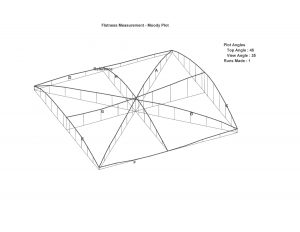
Mae gan Brofi Gwastadrwydd 4 dull cymeradwy. Lefelau electronig, awto-golimeiddio, laser a dyfais o'r enw lleolwr plân. Dim ond lefelau electronig yr ydym yn eu defnyddio oherwydd mai nhw yw'r dull mwyaf cywir a chyflymaf am sawl rheswm.
Mae laserau ac awto-golimyddion yn defnyddio trawst golau syth iawn fel cyfeirnod. Mae rhywun yn gwneud mesuriad sythder o blât wyneb gwenithfaen trwy gymharu'r amrywiad mewn pellter rhwng y plât wyneb a'r trawst golau. Trwy gymryd trawst golau syth, ei daro ar darged adlewyrchydd wrth symud y targed adlewyrchydd i lawr y plât wyneb, mae'r pellter rhwng y trawst a allyrrir a'r trawst dychwelyd yn fesuriad sythder.
Dyma’r broblem gyda’r dull hwn. Mae’r targed a’r ffynhonnell yn cael eu heffeithio gan ddirgryniad, tymheredd amgylchynol, targed sydd ddim yn wastad neu wedi’i grafu, halogiad yn yr awyr, a symudiad aer (ceryntau). Mae’r rhain i gyd yn cyfrannu cydrannau ychwanegol o wall. Ar ben hynny, mae cyfraniad gwall gweithredwr o wiriadau gydag awtocolimator yn fwy.
Gall defnyddiwr awto-golimator profiadol wneud mesuriadau cywir iawn ond mae'n dal i wynebu problemau gyda chysondeb y darlleniadau yn enwedig dros bellteroedd hirach gan fod yr adlewyrchiadau'n tueddu i ledu neu fynd ychydig yn aneglur. Hefyd, mae targed nad yw'n berffaith wastad a diwrnod hir o syllu trwy'r lens yn cynhyrchu gwallau ychwanegol.
Mae dyfais lleoli awyren yn wirion ffôl. Mae'r ddyfais hon yn defnyddio trawst golau eithaf syth (o'i gymharu â thrawst golau colimedig neu laser hynod syth) fel ei chyfeirnod. Nid yn unig y mae'r ddyfais fecanyddol yn defnyddio dangosydd sydd fel arfer â datrysiad o 20 modfedd yn unig, ond mae ansythrwydd y bar a deunyddiau gwahanol yn ychwanegu'n sylweddol at wallau wrth fesur. Yn ein barn ni, er bod y dull yn dderbyniol, ni fyddai unrhyw labordy cymwys byth yn defnyddio dyfais lleoli awyren fel offeryn arolygu terfynol.
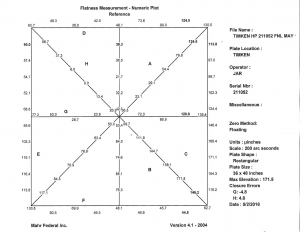
Mae lefelau electronig yn defnyddio disgyrchiant fel eu cyfeirnod. Nid yw lefelau electronig gwahaniaethol yn cael eu heffeithio gan ddirgryniad. Mae ganddynt benderfyniad mor isel â .1 eiliad arc ac mae'r mesuriadau'n gyflym, yn gywir ac ychydig iawn o gyfraniad o wall gan weithredwr profiadol. Nid yw Lleolwyr Plân nac awto-golimyddion yn darparu plotiau topograffig (Ffigur 1) nac isometrig (Ffigur 2) o'r wyneb a gynhyrchir gan gyfrifiadur.
Ffigur 2
Prawf Gwastadrwydd Priodol yr Arwyneb
Mae prawf gwastadrwydd priodol yr wyneb yn rhan mor bwysig o'r papur hwn fel y dylwn fod wedi'i roi ar y dechrau. Fel y nodwyd yn gynharach, NID dull calibradu YW Manyleb Ffederal GGG-p-463c. Mae'n gwasanaethu fel canllaw ar gyfer llawer o agweddau ar wenithfaen gradd metroleg y bwriedir iddo fod yn unrhyw Asiantaeth Llywodraeth Ffederal, ac mae hynny'n cynnwys y dulliau profi a goddefiannau neu raddau. Os yw contractwr yn honni eu bod wedi glynu wrth Fanylebau Ffederal, yna bydd y gwerth gwastadrwydd yn cael ei bennu gan Ddull Moody.
Roedd Moody yn ddyn o'r 50au a ddyfeisiodd ddull mathemategol i bennu gwastadrwydd cyffredinol ac ystyried cyfeiriadedd llinellau a brofwyd, p'un a ydynt yn ddigon agos yn yr un plân. Nid oes dim wedi newid. Ceisiodd Allied Signal wella ar y dull mathemategol ond daeth i'r casgliad bod y gwahaniaethau mor fach fel nad oeddent yn werth yr ymdrech.
Os yw contractwr platiau arwyneb yn defnyddio Lefelau Electronig neu laser, mae'n defnyddio cyfrifiadur i'w gynorthwyo gyda'r cyfrifiadau. Heb gymorth cyfrifiadur, rhaid i'r technegydd sy'n defnyddio awto-golimeiddio gyfrifo'r darlleniadau â llaw. Mewn gwirionedd, nid ydynt yn gwneud hynny. Mae'n cymryd gormod o amser ac, a dweud y gwir, gall fod yn rhy heriol. Mewn prawf gwastadrwydd gan ddefnyddio'r Dull Moody, mae'r technegydd yn profi wyth llinell mewn cyfluniad Jac yr Undeb am sythder.
Y Dull Moody
Mae'r Dull Moody yn ffordd fathemategol o benderfynu a yw'r wyth llinell ar yr un plân. Fel arall, dim ond 8 llinell syth sydd gennych a allai fod ar yr un plân neu'n agos ato. Ymhellach, contractwr sy'n honni ei fod yn glynu wrth Fanyleb y Ffederal, ac yn defnyddio awto-golimeiddio, ferhaidcynhyrchu wyth tudalen o ddata. Un dudalen ar gyfer pob llinell a wiriwyd i brofi ei brofion, ei atgyweiriadau, neu'r ddau. Fel arall, nid oes gan y contractwr unrhyw syniad beth yw'r gwerth gwastadrwydd gwirioneddol.
Rwy'n siŵr os ydych chi'n un o'r rhai sy'n cael eich platiau wedi'u calibro gan gontractwr gan ddefnyddio awto-golimeiddio, nad ydych chi erioed wedi gweld y tudalennau hynny! Mae Ffigur 3 yn sampl odim ond untudalen o wyth yn angenrheidiol i gyfrifo'r gwastadrwydd cyffredinol. Un arwydd o'r anwybodaeth a'r maleis hwnnw yw os oes gan eich adroddiad rifau crwn braf. Er enghraifft, 200, 400, 650, ac ati. Gwerth wedi'i gyfrifo'n iawn yw rhif real. Er enghraifft 325.4 u In. Pan fydd y contractwr yn defnyddio Dull Moody o gyfrifiadau, a bod y technegydd yn cyfrifo'r gwerthoedd â llaw, dylech dderbyn wyth tudalen o gyfrifiadau a phlot isometrig. Mae'r plot isometrig yn dangos yr uchderau amrywiol ar hyd y gwahanol linellau a faint o bellter sy'n gwahanu'r pwyntiau croestoriadol a ddewiswyd.
Ffigur 3(Mae'n cymryd wyth tudalen fel hon i gyfrifo gwastadrwydd â llaw. Gwnewch yn siŵr eich bod yn gofyn pam nad ydych chi'n cael hyn os yw'ch contractwr yn defnyddio awto-golimeiddio!)
Ffigur 4
Mae technegwyr Mesuryddion Dimensiynol yn defnyddio lefelau gwahaniaethol (Ffigur 4) fel dyfeisiau dewisol i fesur y newidiadau bach mewn onglogrwydd o orsaf fesur i orsaf. Mae gan y lefelau benderfyniad i lawr i .1 eiliad arc (5 u Fodfedd gan ddefnyddio sled 4″) maent yn hynod sefydlog, nid ydynt yn cael eu heffeithio gan ddirgryniad, pellteroedd a fesurir, ceryntau aer, blinder gweithredwr, halogiad aer nac unrhyw un o'r problemau sy'n gynhenid mewn dyfeisiau eraill. Ychwanegwch gymorth cyfrifiadurol, ac mae'r dasg yn dod yn gymharol gyflym, gan gynhyrchu plotiau topograffig ac isometrig sy'n profi'r gwiriad ac yn bwysicaf oll yr atgyweiriad.
Prawf Ailadroddadwyedd Priodol
Darllen ailadroddus neu ailadroddadwyedd yw'r prawf pwysicaf. Yr offer a ddefnyddiwn i gyflawni'r prawf ailadroddadwyedd yw gosodiad darllen ailadroddus, LVDT ac atgyfnerthydd sy'n angenrheidiol ar gyfer darlleniadau cydraniad uchel. Rydym yn gosod yr atgyfnerthydd LVDT i gydraniad lleiaf o 10 u Modfedd neu 5 u Modfedd ar gyfer platiau cywirdeb uchel.
Mae defnyddio dangosydd mecanyddol gyda datrysiad o 20 u Fodfedd yn unig yn ddiwerth os ydych chi'n ceisio profi am ofyniad ailadroddadwyedd o 35 u Fodfedd. Mae gan ddangosyddion ansicrwydd o 40 u Fodfedd! Mae'r gosodiad darllen ailadroddus yn dynwared ffurfweddiad mesurydd uchder/rhan.
NID yw ailadroddadwyedd yr un peth â gwastadrwydd cyffredinol (Plân Cymedrig). Rwy'n hoffi meddwl am ailadroddadwyedd mewn gwenithfaen yn cael ei ystyried fel mesuriad radiws cyson.
Ffigur 5
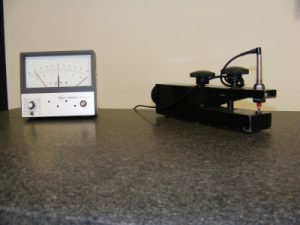
Os ydych chi'n profi am ailadroddadwyedd pêl gron, yna rydych chi wedi dangos nad yw radiws y bêl wedi newid. (Mae gan broffil delfrydol plât sydd wedi'i atgyweirio'n iawn siâp coronog amgrwm.) Fodd bynnag, mae'n amlwg nad yw'r bêl yn wastad. Wel, rhywbeth felly. Ar bellter byr iawn, mae'n wastad. Gan fod y rhan fwyaf o waith archwilio yn cynnwys mesurydd uchder yn agos iawn at y rhan, ailadroddadwyedd yw'r priodwedd bwysicaf o blât gwenithfaen. Mae'n bwysicach na'r gwastadrwydd cyffredinol oni bai bod defnyddiwr yn gwirio sythder rhan hir.
Gwnewch yn siŵr bod eich contractwr yn cynnal prawf darllen ailadroddus. Gall plât gael darlleniad ailadroddus sydd ymhell y tu hwnt i'r goddefgarwch ond dal i basio prawf gwastadrwydd! Yn rhyfeddol, gall labordy gael achrediad mewn profion nad ydynt yn cynnwys prawf darllen ailadroddus. Mae labordy na all atgyweirio neu nad yw'n dda iawn am atgyweirio yn well ganddo gynnal profion gwastadrwydd yn unig. Anaml y bydd gwastadrwydd yn newid oni bai eich bod yn symud y plât.
Profi darllen ailadroddus yw'r hawsaf i'w brofi ond yr anoddaf i'w gyflawni wrth lapio. Gwnewch yn siŵr y gall eich contractwr adfer ailadroddadwyedd heb "anwybyddu" yr wyneb na gadael tonnau yn yr wyneb.
Prawf Delta T
Mae'r prawf hwn yn cynnwys mesur tymheredd GWIRIONEDDOL y garreg ar ei harwyneb uchaf a'i harwyneb gwaelod a chyfrifo'r gwahaniaeth, Delta T, ar gyfer adrodd ar y dystysgrif.
Mae'n bwysig gwybod bod cyfernod ehangu thermol cyfartalog mewn gwenithfaen yn 3.5 uIn/Modfedd/gradd. Mae effaith tymereddau amgylchynol a lleithder ar blât gwenithfaen yn ddibwys. Fodd bynnag, gall plât arwyneb fynd y tu hwnt i oddefgarwch neu weithiau wella hyd yn oed os yw mewn Delta T o .3 – .5 gradd F. Mae angen gwybod a yw'r Delta T o fewn .12 gradd F o ble mae'r gwahaniaeth o'r calibradu diwethaf.
Mae hefyd yn bwysig gwybod bod arwyneb gwaith plât yn mudo tuag at wres. Os yw'r tymheredd uchaf yn gynhesach na'r gwaelod, yna mae'r wyneb uchaf yn codi. Os yw'r gwaelod yn gynhesach, sy'n brin, yna mae'r wyneb uchaf yn suddo. Nid yw'n ddigon i reolwr ansawdd neu dechnegydd wybod bod y plât yn wastad ac yn ailadroddadwy ar adeg y calibradu neu'r atgyweirio ond beth oedd ei Delta T ar adeg y prawf calibradu terfynol. Mewn sefyllfaoedd critigol, gall defnyddiwr, trwy fesur y Delta T ei hun, benderfynu a yw plât wedi mynd allan o oddefgarwch oherwydd amrywiadau Delta T yn unig. Yn ffodus, mae gwenithfaen yn cymryd oriau lawer neu hyd yn oed ddyddiau i addasu i amgylchedd. Ni fydd amrywiadau bach yn nhymheredd amgylchynol trwy gydol y dydd yn effeithio arno. Am y rhesymau hyn, nid ydym yn adrodd tymheredd calibradu amgylchynol na lleithder oherwydd bod yr effeithiau'n ddibwys.
Gwisgo Plât Gwenithfaen
Er bod gwenithfaen yn galetach na phlatiau dur, mae gwenithfaen yn dal i ddatblygu smotiau isel ar yr wyneb. Symudiad ailadroddus rhannau a mesuryddion ar y plât wyneb yw'r ffynhonnell fwyaf o draul, yn enwedig os yw'r un ardal yn cael ei defnyddio'n gyson. Mae baw a llwch malu sy'n aros ar wyneb plât yn cyflymu'r broses draul wrth iddi fynd rhwng rhannau neu fesuryddion ac wyneb y gwenithfaen. Wrth symud rhannau a mesuryddion ar draws ei wyneb, llwch sgraffiniol fel arfer yw achos traul ychwanegol. Rwy'n argymell glanhau cyson yn gryf i leihau traul. Rydym wedi gweld traul ar blatiau a achosir gan ddanfoniadau pecynnau UPS dyddiol yn cael eu gosod ar ben platiau! Mae'r ardaloedd traul lleol hynny'n effeithio ar ddarlleniadau'r prawf ailadroddadwyedd calibradu. Osgowch draul trwy lanhau'n rheolaidd.
Glanhau Platiau Gwenithfaen
I gadw'r plât yn lân, defnyddiwch frethyn tacio i gael gwared â graean. Pwyswch yn ysgafn iawn, fel nad ydych chi'n gadael gweddillion glud. Mae brethyn tacio sydd wedi'i ddefnyddio'n dda yn gwneud gwaith ardderchog o godi llwch malu rhwng glanhau. Peidiwch â gweithio yn yr un fan. Symudwch eich gosodiad o amgylch y plât, gan ddosbarthu'r traul. Mae'n iawn defnyddio alcohol i lanhau plât, ond byddwch yn ymwybodol y bydd gwneud hynny'n oeri'r wyneb dros dro. Mae dŵr gyda swm bach o sebon yn ardderchog. Mae'r glanhawyr sydd ar gael yn fasnachol fel glanhawr Starrett hefyd yn ardderchog i'w defnyddio, ond gwnewch yn siŵr eich bod chi'n cael yr holl weddillion sebon oddi ar yr wyneb.
Atgyweirio Platiau Gwenithfaen
Dylai fod yn amlwg erbyn hyn bwysigrwydd sicrhau bod eich contractwr platiau wyneb yn cynnal calibradu cymwys. Anaml y bydd gan y labordai tebyg i "Glirio" sy'n cynnig rhaglenni "Gwnewch bopeth gydag un alwad" dechnegydd a all wneud atgyweiriadau. Hyd yn oed os ydyn nhw'n cynnig atgyweiriadau, nid oes ganddyn nhw dechnegydd sydd â'r profiad sydd ei angen pan fydd y plât wyneb ymhell y tu hwnt i oddefgarwch.
Os dywedir wrthych na ellir atgyweirio plât oherwydd traul eithafol, ffoniwch ni. Mae'n fwyaf tebygol y gallwn ni wneud yr atgyweiriad.
Mae ein technegwyr yn gweithio prentisiaeth o un i un flwyddyn a hanner o dan Dechnegydd Platiau Arwyneb Meistr. Rydym yn diffinio Dechnegydd Platiau Arwyneb Meistr fel rhywun sydd wedi cwblhau ei brentisiaeth ac sydd â dros ddeng mlynedd ychwanegol o brofiad mewn calibradu ac Atgyweirio Platiau Arwyneb. Mae gennym ni yn Dimensional Gauge dri Dechnegydd Meistr ar staff gyda dros 60 mlynedd o brofiad gyda'i gilydd. Mae un o'n Dechnegwyr Meistr ar gael bob amser i roi cefnogaeth ac arweiniad pan fydd sefyllfaoedd anodd yn codi. Mae gan bob un o'n technegwyr brofiad mewn calibradu platiau arwyneb o bob maint, o fach i fawr iawn, amodau amgylcheddol amrywiol, gwahanol ddiwydiannau, ac mewn problemau traul mawr.
Mae gan Fanylebau Ffed ofyniad gorffen penodol o 16 i 64 o Garwedd Rhifyddeg Cyfartalog (AA). Rydym yn well ganddo orffeniad yn yr ystod o 30-35 AA. Mae digon o garwedd i sicrhau bod rhannau a mesuryddion yn symud yn esmwyth ac nad ydynt yn glynu nac yn gwasgu i'r plât arwyneb.
Pan fyddwn yn atgyweirio, rydym yn archwilio'r plât i sicrhau ei fod yn cael ei osod a'i fod yn wastad. Rydym yn defnyddio dull lapio sych, ond mewn achosion o draul eithafol sy'n gofyn am dynnu gwenithfaen sylweddol, rydym yn lapio'n wlyb. Mae ein technegwyr yn glanhau ar eu hôl eu hunain, maent yn drylwyr, yn gyflym ac yn fanwl gywir. Mae hynny'n bwysig oherwydd bod cost gwasanaeth plât gwenithfaen yn cynnwys eich amser segur a'ch cynhyrchiant coll. Mae atgyweiriad cymwys o'r pwys mwyaf, a ni ddylech byth ddewis contractwr ar sail pris na chyfleustra. Mae rhai gwaith calibradu yn gofyn am unigolion hyfforddedig iawn. Mae hynny gennym ni.
Adroddiadau Calibradu Terfynol
Ar gyfer pob atgyweiriad a graddnodi plât arwyneb, rydym yn darparu adroddiadau proffesiynol manwl. Mae ein hadroddiadau'n cynnwys llawer iawn o wybodaeth hanfodol a pherthnasol. Mae Manyleb Fed. angen y rhan fwyaf o'r wybodaeth a ddarparwyd gennym. Ac eithrio'r rhai sydd wedi'u cynnwys mewn safonau ansawdd eraill fel ISO/IEC-17025, y Manylebau Fed. gofynnol ar gyfer adroddiadau yw:
- Maint mewn Troedfeddi (X' x X')
- Lliw
- Arddull (Yn cyfeirio at silffoedd heb glamp neu ddau neu bedwar silff)
- Modwlws Elastigedd Amcangyfrifedig
- Goddefgarwch Plân Cymedrig (Wedi'i Bennu gan Radd/Maint)
- Goddefgarwch darllen ailadroddus (Wedi'i bennu gan hyd croeslin mewn modfeddi)
- Plân Cymedrig fel y'i Darganfuwyd
- Plân Cymedrig fel y chwith
- Ailadroddwch y darlleniad fel y'i canfuwyd
- Ailadroddwch ddarllen fel y chwith
- Delta T (Gwahaniaeth tymheredd rhwng arwynebau uchaf ac isaf)
Os oes angen i'r technegydd wneud gwaith lapio neu atgyweirio i'r plât arwyneb, yna mae'r dystysgrif calibradu yn dod ynghyd â phlot topograffig neu isometrig i brofi atgyweiriad dilys.
Gair Ynglŷn ag Achrediadau ISO/IEC-17025 a'r labordai sydd â nhw
Dim ond oherwydd bod gan labordy achrediad mewn calibradu platiau arwyneb nid yw o reidrwydd yn golygu eu bod yn gwybod beth maen nhw'n ei wneud, heb sôn am ei wneud yn gywir! Nid yw o reidrwydd yn awgrymu ychwaith y gall y labordy atgyweirio. Nid yw'r cyrff achredu yn gwahaniaethu rhwng gwirio neu galibradu (atgyweirio).Aac rwy'n gwybod am un, efallai2cyrff achredu a fyddLclymuArhuban o amgylch fy nghi pe bawn i wedi talu digon o arian iddyn nhw! Mae'n ffaith drist. Rydw i wedi gweld labordai'n cael achrediad trwy berfformio dim ond un o'r tri phrawf sy'n ofynnol. Ar ben hynny, rydw i wedi gweld labordai'n cael achrediad gydag ansicrwydd afrealistig ac yn cael eu hachredu heb unrhyw brawf na dangos sut y gwnaethon nhw gyfrifo'r gwerthoedd. Mae'n anffodus i gyd.
Crynodeb
Ni allwch danbrisio rôl platiau gwenithfaen manwl gywir. Y cyfeirnod gwastad y mae platiau gwenithfaen yn ei ddarparu yw'r sylfaen y gwnewch yr holl fesuriadau eraill arni.
Gallwch ddefnyddio'r offer mesur mwyaf modern, mwyaf cywir a mwyaf amlbwrpas. Fodd bynnag, mae'n anodd canfod mesuriadau cywir os nad yw'r arwyneb cyfeirio yn wastad. Un tro, dywedodd darpar gwsmer wrthyf "wel, dim ond carreg ydyw!" Fy ymateb i, "Iawn, rydych chi'n gywir, ac yn bendant ni allwch gyfiawnhau cael arbenigwyr i ddod i mewn i gynnal a chadw eich platiau arwyneb."
Nid yw pris byth yn rheswm da dros ddewis contractwyr platiau arwyneb. Nid yw prynwyr, cyfrifwyr a nifer aflonyddgar o beirianwyr ansawdd bob amser yn deall nad yw ail-ardystio platiau gwenithfaen fel ail-ardystio micromedr, caliper neu DMM.
Mae rhai offerynnau angen arbenigedd, nid pris isel. Ar ôl dweud hynny, mae ein cyfraddau'n rhesymol iawn. Yn enwedig er mwyn cael hyder ein bod yn cyflawni'r gwaith yn gywir. Rydym yn mynd ymhell y tu hwnt i ofynion ISO-17025 a Manylebau Ffederal o ran gwerth ychwanegol.
Platiau arwyneb yw'r sylfaen ar gyfer llawer o fesuriadau dimensiynol, ac mae gofalu'n iawn am eich plât arwyneb yn angenrheidiol i sicrhau cywirdeb mesur.
Gwenithfaen yw'r deunydd mwyaf poblogaidd a ddefnyddir ar gyfer platiau wyneb oherwydd ei nodweddion ffisegol delfrydol, megis caledwch wyneb a sensitifrwydd isel i amrywiadau tymheredd. Fodd bynnag, gyda defnydd parhaus mae platiau wyneb yn profi traul.
Mae gwastadrwydd ac ailadroddadwyedd ill dau yn agweddau hanfodol ar gyfer pennu a yw plât yn darparu arwyneb manwl gywir ar gyfer cael mesuriadau cywir. Diffinnir y goddefiannau ar gyfer y ddau agwedd o dan Fanyleb Ffederal GGG-P-463C, DIN, GB, JJS... Gwastadrwydd yw mesur y pellter rhwng y pwynt uchaf (plân y to) a'r pwynt isaf (plân y sylfaen) ar y plât. Mae ailadroddadwyedd yn pennu a ellir ailadrodd mesuriad a gymerir o un ardal ar draws y plât cyfan o fewn y goddefiant a nodwyd. Mae hyn yn sicrhau nad oes unrhyw gopaon na dyffrynnoedd yn y plât. Os nad yw'r darlleniadau o fewn y canllawiau a nodwyd, yna efallai y bydd angen ail-wynebu i ddod â'r mesuriadau yn ôl i'r fanyleb.
Mae angen calibradu platiau wyneb yn rheolaidd i sicrhau gwastadrwydd ac ailadroddadwyedd dros amser. Mae'r grŵp mesur manwl gywirdeb yn Cross wedi'i achredu gan ISO 17025 ar gyfer calibradu gwastadrwydd ac ailadroddadwyedd platiau wyneb. Rydym yn defnyddio System Ardystio Platiau Arwyneb Mahr sy'n cynnwys:
- Dadansoddiad Moody a Phroffil,
- Plotiau Isometrig neu Rhifol,
- Cyfartaledd Rhediad Lluosog, a
- Graddio Awtomatig yn ôl Safonau'r Diwydiant.
Mae Model â Chymorth Cyfrifiadur Mahr yn pennu unrhyw wyriad onglog neu linellol o lefel absoliwt, ac mae'n addas iawn ar gyfer proffilio platiau arwyneb yn fanwl iawn.
Bydd y cyfnodau rhwng calibradu yn amrywio yn dibynnu ar amlder y defnydd, yr amodau amgylcheddol lle mae'r plât wedi'i leoli, a gofynion ansawdd penodol eich cwmni. Gall cynnal a chadw'ch plât wyneb yn iawn ganiatáu cyfnodau hirach rhwng pob calibradu, eich helpu i osgoi'r gost ychwanegol o ail-lapio, ac yn bwysicaf oll yn sicrhau bod y mesuriadau a gewch ar y plât mor gywir â phosibl. Er bod platiau wyneb yn ymddangos yn gadarn, maent yn offerynnau manwl gywir a dylid eu trin felly. Dyma rai pethau i'w hystyried o ran gofalu am eich platiau wyneb:
- Cadwch y plât yn lân, ac os yn bosibl gorchuddiwch ef pan nad yw'n cael ei ddefnyddio
- Ni ddylid gosod dim ar y plât heblaw am fesuryddion neu ddarnau i'w mesur.
- Peidiwch â defnyddio'r un man ar y plât bob tro.
- Os yn bosibl, cylchdrowch y plât o bryd i'w gilydd.
- Parchwch derfyn llwyth eich plât
Gall Sylfaen Gwenithfaen Manwl Gywir Wella Perfformiadau Offer Peiriant
Mae gofynion yn cynyddu'n gyson mewn peirianneg fecanyddol yn gyffredinol ac mewn adeiladu offer peiriant yn benodol. Mae cyflawni'r cywirdeb a'r gwerthoedd perfformiad mwyaf heb gynyddu costau yn heriau cyson i fod yn gystadleuol. Mae gwely'r offer peiriant yn ffactor pendant yma. Felly, mae mwy a mwy o weithgynhyrchwyr offer peiriant yn dibynnu ar wenithfaen. Oherwydd ei baramedrau ffisegol, mae'n cynnig manteision clir na ellir eu cyflawni gyda dur na choncrit polymer.
Mae gwenithfaen yn graig folcanig ddofn fel y'i gelwir ac mae ganddi strwythur dwys a homogenaidd iawn gyda chyfernod ehangu isel iawn, dargludedd thermol isel a dampio dirgryniad uchel.
Isod fe welwch pam mae'r farn gyffredin mai dim ond fel sylfaen peiriant ar gyfer peiriannau mesur cyfesurynnau pen uchel y mae gwenithfaen yn addas yn bennaf wedi dyddio ers tro byd a pham mae'r deunydd naturiol hwn fel sylfaen offer peiriant yn ddewis arall manteisiol iawn i ddur neu haearn bwrw hyd yn oed ar gyfer offer peiriant manwl iawn.
Gallwn gynhyrchu cydrannau gwenithfaen ar gyfer symudiad deinamig, cydrannau gwenithfaen ar gyfer moduron llinol, cydrannau gwenithfaen ar gyfer ndt, cydrannau gwenithfaen ar gyfer pelydr-x, cydrannau gwenithfaen ar gyfer cmm, cydrannau gwenithfaen ar gyfer cnc, gwenithfaen manwl gywir ar gyfer laser, cydrannau gwenithfaen ar gyfer awyrofod, cydrannau gwenithfaen ar gyfer llwyfannau manwl gywir...
Gwerth Ychwanegol Uchel Heb Gostau Ychwanegol
Nid yw'r defnydd cynyddol o wenithfaen mewn peirianneg fecanyddol gymaint oherwydd y cynnydd enfawr ym mhris dur. Yn hytrach, mae oherwydd bod y gwerth ychwanegol i'r offeryn peiriant a gyflawnir gyda gwely peiriant wedi'i wneud o wenithfaen yn bosibl am gost ychwanegol fach iawn neu ddim cost ychwanegol o gwbl. Profir hyn gan gymhariaethau cost gweithgynhyrchwyr offer peiriant adnabyddus yn yr Almaen ac Ewrop.
Ni ellir cyflawni'r enillion sylweddol mewn sefydlogrwydd thermodynamig, dampio dirgryniad a chywirdeb hirdymor a wneir yn bosibl gan wenithfaen gyda gwely haearn bwrw neu ddur, neu dim ond am gost gymharol uchel. Er enghraifft, gall gwallau thermol gyfrif am hyd at 75% o gyfanswm gwall peiriant, gyda meddalwedd yn aml yn ceisio gwneud iawn amdano - gyda llwyddiant cymedrol. Oherwydd ei ddargludedd thermol isel, gwenithfaen yw'r sylfaen well ar gyfer cywirdeb hirdymor.
Gyda goddefgarwch o 1 μm, mae gwenithfaen yn bodloni'r gofynion gwastadrwydd yn rhwydd yn ôl DIN 876 ar gyfer y radd o gywirdeb 00. Gyda gwerth o 6 ar y raddfa caledwch 1 i 10, mae'n hynod o galed, a chyda'i bwysau penodol o 2.8g/cm³ mae bron yn cyrraedd gwerth alwminiwm. Mae hyn hefyd yn arwain at fanteision ychwanegol megis cyfraddau porthiant uwch, cyflymiadau echelin uwch ac estyniad o oes yr offeryn ar gyfer offer peiriant torri. Felly, mae'r newid o wely bwrw i wely peiriant gwenithfaen yn symud yr offeryn peiriant dan sylw i'r dosbarth pen uchel o ran cywirdeb a pherfformiad - heb unrhyw gost ychwanegol.
Ôl-troed Ecolegol Gwell Granit
Mewn cyferbyniad â deunyddiau fel dur neu haearn bwrw, nid oes rhaid cynhyrchu carreg naturiol gyda llawer iawn o ynni a chan ddefnyddio ychwanegion. Dim ond symiau cymharol fach o ynni sydd eu hangen ar gyfer chwarela a thrin arwynebau. Mae hyn yn arwain at ôl troed ecolegol gwell, sydd hyd yn oed ar ddiwedd oes peiriant yn rhagori ar ôl troed dur fel deunydd. Gall y gwely gwenithfaen fod yn sail i beiriant newydd neu gellir ei ddefnyddio at ddibenion hollol wahanol fel rhwygo ar gyfer adeiladu ffyrdd.
Nid oes prinder adnoddau ar gyfer gwenithfaen chwaith. Mae'n graig ddofn a ffurfiwyd o magma o fewn cramen y ddaear. Mae wedi 'aeddfedu' ers miliynau o flynyddoedd ac mae ar gael mewn symiau mawr iawn fel adnodd naturiol ar bron bob cyfandir, gan gynnwys Ewrop gyfan.
Casgliad: Mae'r manteision niferus y gellir eu dangos o wenithfaen o'i gymharu â dur neu haearn bwrw yn cyfiawnhau parodrwydd cynyddol peirianwyr mecanyddol i ddefnyddio'r deunydd naturiol hwn fel sylfaen ar gyfer offer peiriant manwl gywir a pherfformiad uchel. Gellir dod o hyd i wybodaeth fanwl am briodweddau gwenithfaen, sy'n fanteisiol ar gyfer offer peiriant a pheirianneg fecanyddol, yn yr erthygl bellach hon.
Mesuriad ailadroddus yw mesuriad o ardaloedd gwastadrwydd lleol. Mae'r fanyleb Mesuriad Ailadroddus yn nodi y bydd mesuriad a gymerir unrhyw le ar wyneb plât yn ailadrodd o fewn y goddefiant a nodwyd. Mae rheoli gwastadrwydd ardal leol yn dynnach na gwastadrwydd cyffredinol yn gwarantu newid graddol ym mhroffil gwastadrwydd yr wyneb a thrwy hynny leihau gwallau lleol.
Mae'r rhan fwyaf o weithgynhyrchwyr, gan gynnwys brandiau a fewnforir, yn glynu wrth y Fanyleb Ffederal o oddefiannau gwastadrwydd cyffredinol ond mae llawer yn anwybyddu'r mesuriadau ailadroddus. Ni fydd llawer o'r platiau gwerth isel neu gyllideb sydd ar gael yn y farchnad heddiw yn gwarantu mesuriadau ailadroddus. NID yw gwneuthurwr nad yw'n gwarantu mesuriadau ailadroddus yn cynhyrchu platiau sy'n bodloni gofynion ASME B89.3.7-2013 neu Fanyleb Ffederal GGG-P-463c, neu DIN 876, GB, JJS...
Mae'r ddau yn hanfodol i sicrhau arwyneb manwl gywir ar gyfer mesuriadau cywir. Nid yw manyleb gwastadrwydd yn unig yn ddigon i warantu cywirdeb mesur. Cymerwch fel enghraifft, plât arwyneb Archwiliad Gradd A 36 X 48, sy'n bodloni DIM OND y fanyleb gwastadrwydd o .000300". Os yw'r darn sy'n cael ei wirio yn pontio sawl copa, a bod y mesurydd sy'n cael ei ddefnyddio mewn man isel, gallai'r gwall mesur fod y goddefgarwch llawn mewn un ardal, 000300"! Mewn gwirionedd, gall fod yn llawer uwch os yw'r mesurydd yn gorffwys ar lethr llethr.
Mae gwallau o .000600"-.000800" yn bosibl, yn dibynnu ar ddifrifoldeb y llethr, a hyd braich y mesurydd sy'n cael ei ddefnyddio. Pe bai gan y plât hwn fanyleb Ail-fesur o .000050"FIR yna byddai'r gwall mesur yn llai na .000050" waeth ble mae'r mesuriad yn cael ei gymryd ar y plât. Problem arall, sydd fel arfer yn codi pan fydd technegydd heb hyfforddiant yn ceisio ail-wynebu plât ar y safle, yw defnyddio Ail-fesur yn unig i ardystio plât.
NID yw'r offerynnau a ddefnyddir i wirio ailadroddadwyedd wedi'u cynllunio i wirio gwastadrwydd cyffredinol. Pan gânt eu gosod i sero ar arwyneb crwm perffaith, byddant yn parhau i ddarllen sero, boed yr arwyneb hwnnw'n berffaith wastad neu'n berffaith geugrwm neu'n amgrwm 1/2"! Maent yn syml yn gwirio unffurfiaeth yr arwyneb, nid y gwastadrwydd. Dim ond plât sy'n bodloni'r fanyleb gwastadrwydd A'R fanyleb mesur ailadrodd sy'n bodloni gofynion ASME B89.3.7-2013 neu Fanyleb Ffederal GGG-P-463c mewn gwirionedd.
Ask us about or flatness specification and repeat measurement promise by calling +86 19969991659 or emailing INFO@ZHHIMG.COM
Ydy, ond dim ond ar gyfer graddiant tymheredd fertigol penodol y gellir eu gwarantu. Gallai effeithiau ehangu thermol ar y plât achosi newid mewn cywirdeb sy'n fwy na'r goddefiant yn hawdd os oes newid yn y graddiant. Mewn rhai achosion, os yw'r goddefiant yn ddigon tynn, gall y gwres sy'n cael ei amsugno o oleuadau uwchben achosi digon o newid graddiant dros sawl awr.
Mae gan wenithfaen gyfernod ehangu thermol o tua .0000035 modfedd fesul modfedd fesul 1°F. Fel enghraifft: Mae gan blât arwyneb 36" x 48" x 8" gywirdeb o .000075" (1/2 o Radd AA) ar raddiant o 0°F, mae'r top a'r gwaelod yr un tymheredd. Os yw top y plât yn cynhesu i'r pwynt lle mae 1°F yn gynhesach na'r gwaelod, byddai'r cywirdeb yn newid i .000275" amgrwm! Felly, dim ond os oes rheolaeth hinsawdd ddigonol y dylid ystyried archebu plât gyda goddefgarwch tynnach na Gradd AA Labordy.
Dylid cynnal plât arwyneb mewn 3 phwynt, wedi'u lleoli'n ddelfrydol 20% o'r hyd i mewn o bennau'r plât. Dylid lleoli dau gynhalydd 20% o'r lled i mewn o'r ochrau hir, a dylai'r gynhalydd sy'n weddill fod wedi'i ganoli. Dim ond 3 phwynt all orffwys yn gadarn ar unrhyw beth ond arwyneb manwl gywir.
Dylid cynnal y plât yn y pwyntiau hyn yn ystod y broses gynhyrchu, a dylid ei gynnal yn y tri phwynt hyn yn unig tra ei fod yn cael ei ddefnyddio. Bydd ceisio cynnal y plât mewn mwy na thri phwynt yn achosi i'r plât dderbyn ei gefnogaeth o wahanol gyfuniadau o dri phwynt, na fyddant yr un tri phwynt ag y cafodd ei gynnal arnynt yn ystod y broses gynhyrchu. Bydd hyn yn cyflwyno gwallau wrth i'r plât wyro i gydymffurfio â'r trefniant cynnal newydd. Mae gan bob stondin ddur zhhimg drawstiau cynnal a gynlluniwyd i alinio â'r pwyntiau cynnal priodol.
Os yw'r plât wedi'i gefnogi'n iawn, dim ond os yw'ch cais yn galw amdano y mae angen lefelu manwl gywir. Nid oes angen lefelu i gynnal cywirdeb plât sydd wedi'i gefnogi'n iawn.
Pam Dewis Granit ar gyferSylfaenau PeiriannauaCydrannau Metroleg?
Yr ateb yw 'ydw' ar gyfer bron pob cymhwysiad. Mae manteision gwenithfaen yn cynnwys: Dim rhwd na chorydiad, bron yn imiwn i ystumio, dim twmpath digolledu pan gaiff ei nicio, oes gwisgo hirach, gweithrediad llyfnach, mwy o gywirdeb, bron yn anmagnetig, cyfernod ehangu thermol isel, a chost cynnal a chadw isel.
Mae gwenithfaen yn fath o graig igneaidd sy'n cael ei gloddio am ei gryfder, ei ddwysedd, ei wydnwch a'i wrthwynebiad eithafol i gyrydiad. Ond mae gwenithfaen hefyd yn amlbwrpas iawn - nid dim ond ar gyfer sgwariau a phetryalau y mae! Mewn gwirionedd, mae Starrett Tru-Stone yn gweithio'n hyderus gyda chydrannau gwenithfaen wedi'u peiriannu mewn siapiau, onglau a chromliniau o bob amrywiad yn rheolaidd - gyda chanlyniadau rhagorol.
Drwy ein prosesu o'r radd flaenaf, gall arwynebau wedi'u torri fod yn eithriadol o wastad. Mae'r rhinweddau hyn yn gwneud gwenithfaen yn ddeunydd delfrydol i greu seiliau peiriannau a chydrannau metroleg o faint a dyluniad arferol. Mae gwenithfaen yn:
peirianadwy
union wastad pan gaiff ei dorri a'i orffen
gwrthsefyll rhwd
gwydn
hirhoedlog
Mae cydrannau gwenithfaen hefyd yn hawdd i'w glanhau. Wrth greu dyluniadau wedi'u teilwra, gwnewch yn siŵr eich bod yn dewis gwenithfaen oherwydd ei fanteision uwch.
SAFONAU/ CEISIADAU GWISGO UCHEL
Mae gan y gwenithfaen a ddefnyddir gan ZhongHui ar gyfer ein cynhyrchion platiau arwyneb safonol gynnwys cwarts uchel, sy'n darparu mwy o wrthwynebiad i wisgo a difrod. Mae gan ein lliwiau Du a Phinc Grisial Uwch gyfraddau amsugno dŵr isel, gan leihau'r posibilrwydd y bydd eich mesuryddion manwl gywir yn rhydu wrth osod ar y platiau. Mae lliwiau'r gwenithfaen a gynigir gan ZhongHui yn arwain at lai o lewyrch, sy'n golygu llai o straen ar y llygaid i unigolion sy'n defnyddio'r platiau. Rydym wedi dewis ein mathau o wenithfaen gan ystyried ehangu thermol mewn ymdrech i gadw'r agwedd hon i'r lleiafswm.
CEISIADAU ARBENNIG
Pan fydd eich cymhwysiad yn galw am blât gyda siapiau personol, mewnosodiadau edau, slotiau neu beiriannu arall, byddwch chi eisiau dewis deunydd fel Black Diabase. Mae'r deunydd naturiol hwn yn cynnig anystwythder uwch, lliniaru dirgryniad rhagorol, a pheiriannu gwell.
Ydw, os nad ydyn nhw wedi treulio'n rhy ddrwg. Mae ein gosodiad ffatri a'n hoffer yn caniatáu'r amodau gorau posibl ar gyfer calibradu plât priodol ac ailweithio os oes angen. Yn gyffredinol, os yw plât o fewn .001" i'r goddefgarwch gofynnol, gellir ei ail-wynebu ar y safle. Os yw plât wedi treulio i'r pwynt lle mae'n fwy na .001" allan o'r goddefgarwch, neu os yw wedi'i bylu neu ei nicio'n ddrwg, yna bydd angen ei anfon i'r ffatri i'w falu cyn ei ail-lapio.
Dylid bod yn ofalus iawn wrth ddewis technegydd calibradu ac ail-wynebu ar y safle. Rydym yn eich annog i fod yn ofalus wrth ddewis eich gwasanaeth calibradu. Gofynnwch am achrediad a gwiriwch fod gan yr offer y bydd y technegydd yn ei ddefnyddio galibradu olrheiniadwy Sefydliad Arolygu Cenedlaethol. Mae'n cymryd blynyddoedd lawer i ddysgu sut i lapio gwenithfaen manwl gywir yn iawn.
Mae ZhongHui yn darparu amser troi cyflym ar galibradau a gyflawnir yn ein ffatri. Anfonwch eich platiau i mewn i'w calibradu os yn bosibl. Mae eich ansawdd a'ch enw da yn dibynnu ar gywirdeb eich offer mesur gan gynnwys platiau arwyneb!
Mae gan ein platiau wyneb du ddwysedd llawer uwch ac maent hyd at dair gwaith yn fwy anystwyth. Felly, nid oes angen i blât wedi'i wneud o'r du fod mor drwchus â phlât gwenithfaen o'r un maint i gael ymwrthedd cyfartal neu fwy i wyriad. Mae trwch llai yn golygu llai o bwysau a chostau cludo is.
Byddwch yn ofalus o eraill sy'n defnyddio gwenithfaen du o ansawdd is yn yr un trwch. Fel y nodwyd uchod, mae priodweddau gwenithfaen, fel pren neu fetel, yn amrywio yn ôl deunydd a lliw, ac nid yw'n rhagfynegydd cywir o anystwythder, caledwch, na gwrthiant gwisgo. Mewn gwirionedd, mae llawer o fathau o wenithfaen du a diabas yn feddal iawn ac nid ydynt yn addas ar gyfer cymwysiadau platiau arwyneb.
Na. Mae'r offer arbenigol a'r hyfforddiant sy'n angenrheidiol i ailweithio'r eitemau hyn yn ei gwneud yn ofynnol eu dychwelyd i'r ffatri i'w calibradu a'u hailweithio.
Ydy. Mae gan serameg a gwenithfaen nodweddion tebyg, a gellir defnyddio'r dulliau a ddefnyddir i galibro a lapio gwenithfaen gydag eitemau serameg hefyd. Mae serameg yn anoddach i'w lapio na gwenithfaen gan arwain at gost uwch.
Ydw, ar yr amod bod y mewnosodiadau wedi'u cilfachau o dan yr wyneb. Os yw mewnosodiadau dur yn wastad â, neu uwchben plân yr wyneb, rhaid eu gorchuddio â'r wyneb cyn y gellir lapio'r plât. Os oes angen, gallwn ddarparu'r gwasanaeth hwnnw.
Ydw. Gellir bondio mewnosodiadau dur gyda'r edau a ddymunir (Saesneg neu fetrig) ag epocsi i'r plât yn y lleoliadau a ddymunir. Mae ZhongHui yn defnyddio peiriannau CNC i ddarparu'r lleoliadau mewnosod tynnaf o fewn +/- 0.005”. Ar gyfer mewnosodiadau llai critigol, ein goddefgarwch lleoliadol ar gyfer mewnosodiadau edau yw ±.060”. Mae opsiynau eraill yn cynnwys Bariau-T dur a slotiau cynffon colomennod wedi'u peiriannu'n uniongyrchol i'r gwenithfaen.
Bydd mewnosodiadau sydd wedi'u bondio'n iawn gan ddefnyddio epocsi cryfder uchel a chrefftwaith da yn gwrthsefyll llawer iawn o rym torsiwn a chneifio. Mewn prawf diweddar, gan ddefnyddio mewnosodiadau edau 3/8"-16, mesurodd labordy profi annibynnol y grym sydd ei angen i dynnu mewnosodiad wedi'i fondio ag epocsi o blât arwyneb. Profwyd deg plât. O'r deg hyn, mewn naw achos, torrodd y gwenithfaen yn gyntaf. Y llwyth cyfartalog ar bwynt y methiant oedd 10,020 pwys ar gyfer gwenithfaen llwyd a 12,310 pwys ar gyfer du. Yn yr un achos lle tynnwyd mewnosodiad yn rhydd o'r plât, y llwyth ar bwynt y methiant oedd 12,990 pwys! Os yw darn gwaith yn ffurfio pont ar draws y mewnosodiad a bod trorym eithafol yn cael ei gymhwyso, mae'n bosibl cynhyrchu digon o rym i dorri'r gwenithfaen. Yn rhannol am y rheswm hwn, mae ZhongHui yn rhoi canllawiau ar gyfer y trorym diogel mwyaf y gellir ei gymhwyso i'r mewnosodiadau wedi'u bondio ag epocsi: https://www.zhhimg.com/standard-thread-inserts-product/
Ydw, ond yn ein ffatri yn unig. Yn ein ffatri, gallwn adfer bron unrhyw blât i gyflwr 'fel newydd', fel arfer am lai na hanner cost ei ddisodli. Gellir trwsio ymylon sydd wedi'u difrodi yn gosmetig, gellir malu rhigolau dwfn, niciau a phyllau, a gellir disodli'r cynhalwyr sydd ynghlwm. Yn ogystal, gallwn addasu eich plât i gynyddu ei hyblygrwydd trwy ychwanegu mewnosodiadau dur solet neu edau a thorri slotiau neu wefusau clampio, yn unol â'ch manylebau.
Pam Dewis Granit?
Mae gwenithfaen yn fath o graig igneaidd a ffurfiwyd yn y Ddaear filiynau o flynyddoedd yn ôl. Roedd cyfansoddiad y graig igneaidd yn cynnwys llawer o fwynau fel cwarts sy'n hynod o galed ac yn gwrthsefyll traul. Yn ogystal â chaledwch a gwrthsefyll traul, mae gan wenithfaen tua hanner y cyfernod ehangu â haearn bwrw. Gan fod ei bwysau cyfaint tua thraean o bwysau haearn bwrw, mae gwenithfaen yn haws i'w symud.
Ar gyfer sylfeini peiriannau a chydrannau metroleg, gwenithfaen du yw'r lliw a ddefnyddir fwyaf. Mae gan wenithfaen du ganran uwch o gwarts na lliwiau eraill ac, felly, dyma'r un sy'n gwisgo galetaf.
Mae gwenithfaen yn gost-effeithiol, a gall arwynebau wedi'u torri fod yn eithriadol o wastad. Nid yn unig y gellir ei lapio â llaw i gyflawni cywirdeb eithafol, ond gellir ei ailgyflyru heb symud y plât na'r bwrdd oddi ar y safle. Mae'n weithrediad lapio â llaw yn gyfan gwbl ac yn gyffredinol mae'n costio llawer llai nag ailgyflyru dewis arall haearn bwrw.
Mae'r rhinweddau hyn yn gwneud gwenithfaen yn ddeunydd delfrydol i greu seiliau peiriannau a chydrannau metroleg o faint a dyluniad arferol fel yplât wyneb gwenithfaen.
Mae ZhongHui yn cynhyrchu cynhyrchion gwenithfaen pwrpasol sydd wedi'u creu i gefnogi gofynion mesur penodol. Mae'r eitemau pwrpasol hyn yn amrywio oymylon syth totri sgwariauOherwydd natur amlbwrpas gwenithfaen, ycydrannaugellir eu cynhyrchu i unrhyw faint sydd ei angen; maent yn wydn ac yn para'n hir.
Manteision Platiau Arwyneb Gwenithfaen
Sefydlwyd pwysigrwydd mesur ar arwyneb gwastad gan y dyfeisiwr Prydeinig Henry Maudsley yn y 1800au. Fel arloeswr offer peiriant, penderfynodd fod cynhyrchu rhannau cyson yn gofyn am arwyneb solet ar gyfer mesuriadau dibynadwy.
Creodd y chwyldro diwydiannol alw am arwynebau mesur, felly creodd y cwmni peirianneg Crown Windley safonau gweithgynhyrchu. Gosodwyd y safonau ar gyfer platiau arwyneb gyntaf gan Crown ym 1904 gan ddefnyddio metel. Wrth i'r galw a'r gost am fetel gynyddu, ymchwiliwyd i ddeunyddiau amgen ar gyfer yr arwyneb mesur.
Yn America, sefydlodd crëwr y cofebau, Wallace Herman, fod gwenithfaen du yn ddeunydd plât arwyneb rhagorol yn lle metel. Gan nad yw gwenithfaen yn fagnetig ac nad yw'n rhydu, daeth yn fuan yn arwyneb mesur dewisol.
Mae plât wyneb gwenithfaen yn fuddsoddiad hanfodol ar gyfer labordai a chyfleusterau profi. Gellir gosod plât wyneb gwenithfaen o 600 x 600 mm ar stondin gefnogi. Mae'r stondinau'n darparu uchder gweithio o 34” (0.86m) gyda phum pwynt addasadwy ar gyfer lefelu.
Ar gyfer canlyniadau mesur dibynadwy a chyson, mae plât arwyneb gwenithfaen yn hanfodol. Gan fod yr arwyneb yn wastadedd llyfn a sefydlog, mae'n galluogi trin offerynnau'n ofalus.
Prif fanteision platiau wyneb gwenithfaen yw:
• Di-adlewyrchol
• Yn gwrthsefyll cemegau a chorydiad
• Cyfernod ehangu isel o'i gymharu â haearn cart felly llai o effaith gan newid tymheredd
• Yn naturiol anhyblyg ac yn wydn
• Ni effeithir ar blân yr wyneb os caiff ei grafu
• Ni fydd yn rhydu
• Anmagnetig
• Hawdd i'w lanhau a'i gynnal
• Gellir gwneud calibradu ac ail-wynebu ar y safle
• Addas ar gyfer drilio ar gyfer mewnosodiadau cymorth edau
• Dampio dirgryniad uchel
I lawer o siopau, ystafelloedd archwilio a labordai, mae platiau wyneb gwenithfaen manwl gywir yn cael eu dibynnu ar sail mesur cywir. Gan fod pob mesuriad llinol yn dibynnu ar arwyneb cyfeirio cywir y cymerir y dimensiynau terfynol ohono, mae platiau wyneb yn darparu'r plân cyfeirio gorau ar gyfer archwilio a chynllunio gwaith cyn peiriannu. Maent hefyd yn seiliau delfrydol ar gyfer gwneud mesuriadau uchder a mesur arwynebau. Ymhellach, mae gradd uchel o wastadrwydd, sefydlogrwydd, ansawdd cyffredinol a chrefftwaith yn eu gwneud yn ddewis da ar gyfer gosod systemau mesur mecanyddol, electronig ac optegol soffistigedig. Ar gyfer unrhyw un o'r prosesau mesur hyn, mae'n hanfodol cadw platiau wyneb wedi'u calibro.
Ailadrodd Mesuriadau a Gwastadrwydd
Mae gwastadrwydd ac ailadrodd mesuriadau yn hanfodol i sicrhau arwyneb manwl gywir. Gellir ystyried gwastadrwydd fel pob pwynt ar yr wyneb wedi'i gynnwys o fewn dau awyren gyfochrog, sef awyren y sylfaen a awyren y to. Mesuriad y pellter rhwng yr awyrennau yw gwastadrwydd cyffredinol yr wyneb. Mae gan y mesuriad gwastadrwydd hwn fel arfer oddefgarwch a gall gynnwys dynodiad gradd.
Diffinnir y goddefiannau gwastadrwydd ar gyfer tair gradd safonol yn y fanyleb ffederal fel y'u pennir gan y fformiwla ganlynol:
Gradd Labordy AA = (40 + croeslin² / 25) x 0.000001 modfedd (unochrog)
Gradd Arolygu A = Gradd Labordy AA x 2
Ystafell Offer Gradd B = Labordy Gradd AA x 4
Yn ogystal â gwastadrwydd, rhaid sicrhau ailadroddadwyedd. Mesuriad o ardaloedd gwastadrwydd lleol yw mesuriad ailadroddus. Mae'n fesuriad a gymerir yn unrhyw le ar wyneb plât a fydd yn ailadrodd o fewn y goddefiant a nodwyd. Mae rheoli gwastadrwydd ardal leol i oddefiant tynnach na gwastadrwydd cyffredinol yn gwarantu newid graddol ym mhroffil gwastadrwydd yr wyneb, a thrwy hynny leihau gwallau lleol.
Er mwyn sicrhau bod plât arwyneb yn bodloni'r manylebau gwastadrwydd ac ailadrodd mesur, dylai gweithgynhyrchwyr platiau arwyneb gwenithfaen ddefnyddio Manyleb Ffederal GGG-P-463c fel sail ar gyfer eu manylebau. Mae'r safon hon yn mynd i'r afael â chywirdeb ailadrodd mesur, priodweddau deunydd gwenithfaen platiau arwyneb, gorffeniad arwyneb, lleoliad pwynt cynnal, anystwythder, dulliau arolygu derbyniol a gosod mewnosodiadau edau.
Cyn i blât arwyneb wisgo y tu hwnt i'r fanyleb ar gyfer gwastadrwydd cyffredinol, bydd yn dangos pyst treulio neu donnog. Bydd archwiliad misol am wallau mesur ailadroddus gan ddefnyddio mesurydd darllen ailadroddus yn nodi mannau gwisgo. Mae mesurydd darllen ailadroddus yn offeryn manwl iawn sy'n canfod gwall lleol a gellir ei arddangos ar fwyhadur electronig chwyddiad uchel.
Gwirio Cywirdeb y Plât
Drwy ddilyn ychydig o ganllawiau syml, dylai buddsoddiad mewn plât wyneb gwenithfaen bara am flynyddoedd lawer. Yn dibynnu ar y defnydd o'r plât, amgylchedd y siop a'r cywirdeb gofynnol, mae amlder gwirio cywirdeb y plât wyneb yn amrywio. Rheol gyffredinol yw i blât newydd gael ei ail-raddnodi'n llawn o fewn blwyddyn i'w brynu. Os defnyddir y plât yn aml, mae'n ddoeth byrhau'r cyfnod hwn i chwe mis.
Cyn i blât arwyneb wisgo y tu hwnt i'r fanyleb ar gyfer gwastadrwydd cyffredinol, bydd yn dangos pyst treulio neu donnog. Bydd archwiliad misol am wallau mesur ailadroddus gan ddefnyddio mesurydd darllen ailadroddus yn nodi mannau gwisgo. Mae mesurydd darllen ailadroddus yn offeryn manwl iawn sy'n canfod gwall lleol a gellir ei arddangos ar fwyhadur electronig chwyddiad uchel.
Dylai rhaglen arolygu effeithiol gynnwys gwiriadau rheolaidd gydag awtocolimator, gan ddarparu calibradu gwirioneddol o wastadrwydd cyffredinol y gellir ei olrhain i'r Sefydliad Cenedlaethol Safonau a Thechnoleg (NIST). Mae angen calibradu cynhwysfawr gan y gwneuthurwr neu gwmni annibynnol o bryd i'w gilydd.
Amrywiadau Rhwng Calibradau
Mewn rhai achosion, mae amrywiadau rhwng calibradiadau platiau arwyneb. Weithiau gall ffactorau fel newid arwyneb sy'n deillio o wisgo, defnydd anghywir o offer archwilio neu ddefnyddio offer heb ei galibro gyfrif am yr amrywiadau hyn. Y ddau ffactor mwyaf cyffredin, fodd bynnag, yw tymheredd a chefnogaeth.
Un o'r newidynnau pwysicaf yw tymheredd. Er enghraifft, efallai bod yr wyneb wedi'i olchi â thoddiant poeth neu oer cyn calibradu ac nad yw wedi cael digon o amser i normaleiddio. Mae achosion eraill o newid tymheredd yn cynnwys drafftiau o aer oer neu boeth, golau haul uniongyrchol, goleuadau uwchben neu ffynonellau eraill o wres ymbelydrol ar wyneb y plât.
Gall fod amrywiadau hefyd yn y graddiant tymheredd fertigol rhwng y gaeaf a'r haf. Mewn rhai achosion, ni chaniateir digon o amser i'r plât normaleiddio ar ôl ei gludo. Mae'n syniad da cofnodi'r tymheredd graddiant fertigol ar yr adeg y perfformir y calibradu.
Achos cyffredin arall dros amrywiad calibradu yw plât sydd wedi'i gefnogi'n amhriodol. Dylid cefnogi plât arwyneb mewn tair pwynt, wedi'u lleoli'n ddelfrydol 20% o'r hyd i mewn o bennau'r plât. Dylid lleoli dau gefnogaeth 20% o'r lled i mewn o'r ochrau hir, a dylid canoli'r gefnogaeth sy'n weddill.
Dim ond tri phwynt all orffwys yn gadarn ar unrhyw beth ond arwyneb manwl gywir. Bydd ceisio cynnal y plât mewn mwy na thri phwynt yn achosi i'r plât dderbyn ei gefnogaeth o wahanol gyfuniadau o dri phwynt, na fyddant yr un tri phwynt ag y cafodd ei gynnal arnynt yn ystod y cynhyrchiad. Bydd hyn yn cyflwyno gwallau wrth i'r plât wyro i gydymffurfio â'r trefniant cynnal newydd. Ystyriwch ddefnyddio standiau dur gyda thrawstiau cynnal wedi'u cynllunio i alinio â'r pwyntiau cynnal priodol. Mae standiau at y diben hwn ar gael yn gyffredinol gan wneuthurwr y plât arwyneb.
Os yw'r plât wedi'i gynnal yn iawn, dim ond os yw cymhwysiad yn ei nodi y mae angen lefelu manwl gywir. Nid oes angen lefelu i gynnal cywirdeb plât sydd wedi'i gynnal yn iawn.
Mae'n bwysig cadw'r plât yn lân. Llwch sgraffiniol yn yr awyr fel arfer yw'r ffynhonnell fwyaf o draul a rhwyg ar blât, gan ei fod yn tueddu i ymgorffori mewn darnau gwaith ac arwynebau cyswllt mesuryddion. Gorchuddiwch blatiau i'w hamddiffyn rhag llwch a difrod. Gellir ymestyn oes traul trwy orchuddio'r plât pan nad yw'n cael ei ddefnyddio.
Ymestyn Bywyd y Plât
Bydd dilyn ychydig o ganllawiau yn lleihau traul ar blât wyneb gwenithfaen ac yn y pen draw, yn ymestyn ei oes.
Yn gyntaf, mae'n bwysig cadw'r plât yn lân. Llwch sgraffiniol yn yr awyr fel arfer yw'r ffynhonnell fwyaf o draul a rhwyg ar blât, gan ei fod yn tueddu i ymgorffori mewn darnau gwaith ac arwynebau cyswllt mesuryddion.
Mae hefyd yn bwysig gorchuddio platiau i'w hamddiffyn rhag llwch a difrod. Gellir ymestyn oes gwisgo trwy orchuddio'r plât pan nad yw'n cael ei ddefnyddio.
Cylchdrowch y plât o bryd i'w gilydd fel nad yw un ardal yn cael ei defnyddio'n ormodol. Hefyd, argymhellir disodli padiau cyswllt dur ar fesuryddion gyda phadiau carbid.
Osgowch osod bwyd neu ddiodydd meddal ar y plât. Mae llawer o ddiodydd meddal yn cynnwys asid carbonig neu ffosfforig, a all doddi'r mwynau meddalach a gadael pyllau bach yn yr wyneb.
Ble i Ail-ymddangos
Pan fydd angen ail-wynebu plât wyneb gwenithfaen, ystyriwch a ddylid cael y gwasanaeth hwn wedi'i gyflawni ar y safle neu yn y cyfleuster calibradu. Mae bob amser yn well cael y plât wedi'i ail-lapio yn y ffatri neu gyfleuster pwrpasol. Fodd bynnag, os nad yw'r plât wedi treulio'n rhy ddrwg, fel arfer o fewn 0.001 modfedd i'r goddefgarwch gofynnol, gellir ei ail-wynebu ar y safle. Os yw plât wedi treulio i'r pwynt lle mae fwy na 0.001 modfedd y tu allan i'r goddefgarwch, neu os yw wedi'i bylu neu ei nicio'n ddrwg, yna dylid ei anfon i'r ffatri i'w falu cyn ei ail-lapio.
Mae gan gyfleuster calibradu'r offer a'r gosodiadau ffatri sy'n darparu'r amodau gorau posibl ar gyfer calibradu platiau priodol ac ailweithio os oes angen.
Dylid bod yn ofalus iawn wrth ddewis technegydd calibradu ac ail-wynebu ar y safle. Gofynnwch am achrediad a gwiriwch fod gan yr offer y bydd y technegydd yn ei ddefnyddio galibradu y gellir ei olrhain gan NIST. Mae profiad hefyd yn ffactor pwysig, gan ei fod yn cymryd blynyddoedd lawer i ddysgu sut i lapio gwenithfaen manwl gywir.
Mae mesuriadau critigol yn dechrau gyda phlât wyneb gwenithfaen manwl gywir fel llinell sylfaen. Drwy sicrhau cyfeirnod dibynadwy trwy ddefnyddio plât wyneb wedi'i galibro'n iawn, mae gan weithgynhyrchwyr un o'r offer hanfodol ar gyfer mesuriadau dibynadwy a rhannau o ansawdd gwell.
Rhestr wirio ar gyfer Amrywiadau Calibradu
- Golchwyd yr wyneb â thoddiant poeth neu oer cyn calibradu ac ni chaniatawyd digon o amser iddo normaleiddio.
- Mae'r plât wedi'i gefnogi'n amhriodol.
- Newid tymheredd.
- Drafftiau.
- Golau haul uniongyrchol neu wres ymbelydrol arall ar wyneb y plât. Gwnewch yn siŵr nad yw goleuadau uwchben yn cynhesu'r wyneb.
- Amrywiadau yn y graddiant tymheredd fertigol rhwng y gaeaf a'r haf. Os yn bosibl o gwbl, gwyddoch y tymheredd graddiant fertigol ar yr adeg y perfformir y calibradu.
- Ni chaniatawyd digon o amser i'r plât normaleiddio ar ôl ei gludo.
- Defnydd amhriodol o offer archwilio neu ddefnyddio offer heb ei galibro.
- Newid arwyneb o ganlyniad i wisgo.
Awgrymiadau Technegol
Gan fod pob mesuriad llinol yn dibynnu ar arwyneb cyfeirio cywir y cymerir y dimensiynau terfynol ohono, mae platiau arwyneb yn darparu'r plân cyfeirio gorau ar gyfer archwilio a chynllunio gwaith cyn peiriannu.
Mae rheoli gwastadrwydd ardal leol i oddefgarwch tynnach na gwastadrwydd cyffredinol yn gwarantu newid graddol ym mhroffil gwastadrwydd yr arwyneb, a thrwy hynny leihau gwallau lleol.